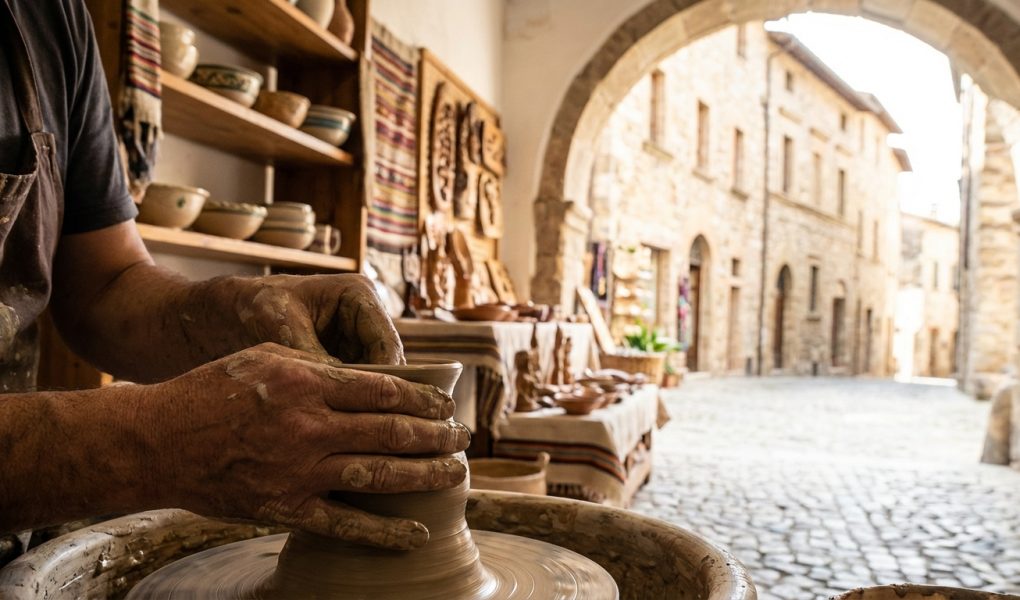
When a Moroccan potter shapes clay using techniques passed down for twelve generations, she’s not just making a bowl. She’s encoding her community’s relationship with water, hospitality, and the desert landscape into every curve. The glaze colors come from local minerals. The patterns reference tribal symbols. Even the firing method connects to regional fuel sources and climate conditions.
This is how local crafts reflect destination culture in the most tangible way possible. Every handmade object carries embedded information about geography, history, social structures, and belief systems that no guidebook can fully capture.
Traditional crafts function as cultural archives, preserving local knowledge through materials, techniques, and designs. Artisan work reveals how communities have adapted to their environment, organized socially, and expressed spiritual beliefs. By understanding the relationship between craft and culture, travelers gain authentic insight that transforms superficial sightseeing into meaningful cultural exchange and supports sustainable local economies.
Materials tell stories about place
The raw materials artisans use reveal everything about local geography and climate.
Japanese washi papermakers work exclusively with kozo, mitsumata, and gampi plants that thrive in the country’s mountainous regions. The fibers require specific humidity levels found in traditional production areas. You can’t make authentic washi in Arizona.
Similarly, Navajo weavers use wool from Churro sheep, a breed that adapted to the Southwest over centuries. The lanolin content differs from other sheep breeds, affecting how the wool accepts natural dyes made from local plants like rabbitbrush and cota.
In the Faroe Islands, knitters work with wool from sheep that graze on salt-sprayed coastal grass. The resulting yarn has water-resistant properties you won’t find in merino from New Zealand.
Material choices aren’t random. They represent generations of experimentation with what the land provides.
Climate shapes technique
How artisans work depends heavily on local weather patterns.
Thai silk weavers maintain specific humidity levels in their workshops because dry air causes threads to snap. The rainy season actually improves working conditions.
Mexican pottery traditions in Oaxaca involve sun-drying pieces for exact periods based on altitude and seasonal temperatures. Move the same technique to a different elevation and everything fails.
Scandinavian woodworkers time their harvesting to winter months when sap content is lowest. Summer wood behaves completely differently under carving tools.
These aren’t preferences. They’re requirements born from environmental reality.
Design patterns encode cultural values
Geometric patterns in Islamic tilework aren’t just decorative. They reflect theological principles about infinity and the nature of creation. Artisans spend years learning the mathematical relationships that govern pattern development.
Maori carving includes specific symbols that denote family lineage, tribal affiliations, and spiritual concepts. A koru spiral represents new beginnings. Certain patterns can only be used by people with particular ancestry.
Andean textile patterns communicate village identity, marital status, and social role. An experienced weaver can look at someone’s clothing and know exactly where they’re from and their position in the community.
“Every stitch in traditional embroidery carries meaning. We’re not making pictures. We’re writing in a language older than the alphabet.” — Master embroiderer in Transylvania
Western observers often miss this entirely, seeing only “pretty designs” instead of sophisticated communication systems.
Production methods preserve collective knowledge
Traditional craft techniques contain solutions to problems that took centuries to solve.
Japanese sword-making involves folding steel thousands of times to create layered structures that are both flexible and hard. This wasn’t artistic flourish. It was metallurgical engineering developed before anyone understood carbon content or crystalline structures.
Venetian glassblowers on Murano guard techniques for creating specific colors that depend on precise temperature control and ingredient ratios. These formulas represent hundreds of years of experimental refinement.
Peruvian backstrap weaving allows for pattern complexity that modern industrial looms can’t replicate. The technique distributes tension in ways that enable three-dimensional effects impossible with mechanical systems.
When these methods disappear, we lose functional knowledge, not just cultural heritage.
How to recognize authentic technique
Spotting genuine traditional methods versus tourist-oriented shortcuts takes practice.
| Authentic Indicator | Tourist Production Shortcut |
|---|---|
| Irregular variations in handwork | Perfect uniformity across all pieces |
| Local material sourcing | Imported synthetic materials |
| Time-intensive processes visible in pricing | Suspiciously low prices for “handmade” items |
| Artisan can explain technique in detail | Vague descriptions of production methods |
| Work shows tool marks specific to traditional implements | Machine-precise edges and patterns |
| Natural dyes with color variation | Chemical dyes with flat, consistent color |
Authentic work costs more because it takes longer and requires genuine skill.
Social structures appear in workshop organization
How craft communities organize themselves reveals cultural attitudes about learning, hierarchy, and knowledge transmission.
The Japanese apprenticeship system for crafts like ceramics or lacquerware involves years of menial tasks before apprentices touch actual production. This reflects broader cultural values about patience, respect for mastery, and incremental learning.
Moroccan carpet cooperatives run by Berber women operate as collective enterprises where profits distribute according to complex formulas considering family size, weaving speed, and design contribution. The economic model mirrors traditional tribal resource-sharing systems.
In Bali, craft guilds connect directly to village temple responsibilities. Artisan families hold hereditary obligations to produce specific ceremonial objects. Social and spiritual roles intertwine completely.
Understanding these structures helps travelers recognize that buying crafts isn’t just commerce. It’s participating in cultural systems with deep roots.
Religious and spiritual beliefs shape aesthetics
Sacred concepts influence what artisans make and how they make it.
Tibetan thangka painters follow strict iconographic rules derived from Buddhist texts. Colors, proportions, and symbolic elements must conform to religious specifications. Personal artistic expression matters far less than accurate transmission of spiritual knowledge.
Pueblo pottery makers in the American Southwest incorporate prayers into their work process. Certain designs reference origin stories and cosmological concepts. The act of making is itself ceremonial.
Hindu artisans in India observe ritual purification before working on temple sculptures or devotional objects. The maker’s spiritual state is considered as important as technical skill.
These aren’t superstitions. They’re integrated worldviews where sacred and practical realms don’t separate.
Finding genuine craft experiences while traveling
Most travelers encounter crafts in tourist markets where context disappears completely.
Here’s how to find more meaningful encounters:
-
Visit artisan workshops during production hours, not just showrooms. Watching someone actually work reveals far more than examining finished products. Many craftspeople welcome observers if you ask respectfully and don’t interrupt.
-
Attend craft schools or cultural centers that offer demonstration programs. These settings provide context that markets can’t. You’ll learn about material sourcing, tool-making, and the years of training required for mastery.
-
Participate in hands-on workshops led by practicing artisans. Even a few hours attempting a traditional technique gives you profound respect for the skill involved. Your clumsy results highlight the expertise in professional work.
-
Time visits to coincide with craft festivals or artisan fairs. These events often include demonstrations, competitions, and opportunities to meet multiple makers. Learning basic phrases in the local language helps enormously during these interactions.
-
Hire local guides who specialize in craft tourism. They have relationships with artisans and can arrange access to workshops that don’t normally receive visitors. The context they provide transforms what you’re seeing.
Questions to ask artisans
Meaningful conversations with craftspeople require moving past “how long did this take” questions.
Try these instead:
- Where do you source your materials and why those specific sources?
- How did you learn this technique and who taught your teacher?
- What aspects of the work have changed in your lifetime?
- Which tools do you make yourself versus purchase?
- How do you decide when a piece is finished?
- What mistakes do beginners always make?
These questions invite stories instead of facts. You’ll learn far more about cultural context.
Economic realities of traditional crafts
Understanding the economics helps travelers make informed purchasing decisions.
Traditional crafts face brutal market pressures. Machine-made imitations sell for a fraction of handmade prices. Young people often abandon craft training for more lucrative careers. Tourism can provide crucial income but also distorts production toward items visitors want rather than what communities actually use.
A master weaver in Guatemala might spend three months creating a complex textile that sells for $200. That’s less than $3 per day. Meanwhile, machine-made approximations flood markets at $30.
When you buy authentic work at fair prices, you’re voting for cultural preservation with your wallet.
How to ensure your money supports artisans
Many souvenir purchases never reach the people who made the items.
- Buy directly from makers when possible, eliminating middlemen who take large percentages.
- Ask about cooperative structures where profits distribute among artisan communities.
- Research fair trade certifications relevant to the region and craft type.
- Be willing to pay prices that reflect actual labor investment.
- Commission custom work when you can, providing income for extended production time.
- Support organizations that provide craft training to younger generations.
The cheapest option rarely benefits the culture you’re trying to appreciate.
Common mistakes travelers make with local crafts
Even well-intentioned visitors often misunderstand what they’re encountering.
Treating everything as decorative: Many traditional objects serve functional or ceremonial purposes in their original context. Removing that context reduces them to mere aesthetics.
Haggling inappropriately: In some cultures, negotiating prices is expected and enjoyable. In others, it’s insulting, especially for sacred or ceremonial items. Read the cultural context carefully.
Ignoring export restrictions: Many countries prohibit exporting antique crafts, items made from protected materials, or objects with cultural significance. Research regulations before purchasing.
Assuming all handmade items are “authentic”: Plenty of handmade tourist goods have no connection to local tradition. They’re designed specifically for visitor consumption.
Photographing artisans without permission: Some craftspeople consider their techniques proprietary. Others have spiritual objections to photography during certain work phases. Always ask first.
Expecting museum-quality explanations: Most practicing artisans are makers, not educators. They may not articulate cultural context the way academics would. Observe carefully and ask specific questions.
Regional craft traditions worth seeking out
Certain destinations offer particularly rich craft experiences that illuminate cultural depth.
Kyoto, Japan: The concentration of traditional crafts here is extraordinary. Kiyomizu-yaki pottery, Nishijin textiles, yuzen dyeing, and bamboo crafts all maintain active production with opportunities for observation and learning. Exploring Japan beyond the major cities reveals even more specialized regional traditions.
Oaxaca, Mexico: Black pottery from San Bartolo Coyotepec, alebrijes wood carvings, and textile weaving from Teotitlán del Valle represent distinct indigenous traditions with pre-Columbian roots. Many workshops welcome visitors.
Fez, Morocco: The medina contains centuries-old craft quarters where leather tanners, metalworkers, and tile makers use largely unchanged methods. The Moroccan desert adventure can include stops at Berber weaving cooperatives.
Bali, Indonesia: Wood carving, silver working, and textile production remain integrated into village life rather than existing solely for tourism. Temple ceremonies still require traditional craft objects.
Rajasthan, India: Block printing, miniature painting, and jewelry-making traditions continue in family workshops that have operated for generations. The connection between craft and caste systems remains visible.
Craft tourism and cultural sustainability
The relationship between visitors and traditional crafts creates complex dynamics.
Tourism income can prevent craft traditions from disappearing. When artisans earn decent livings, they continue practicing and teaching skills to the next generation. Communities maintain cultural knowledge that might otherwise vanish.
But tourism also creates pressure to modify traditions. Artisans might simplify techniques to increase production speed. They might alter designs to match visitor preferences rather than cultural standards. Sacred objects become commodified.
The most sustainable approach involves travelers who:
- Prioritize learning over acquiring
- Accept that not everything is for sale
- Pay prices that reflect true value
- Respect when photography or observation isn’t welcome
- Understand they’re guests in working communities, not entertainment consumers
Your role as a visitor matters enormously to how these interactions unfold.
Why craft knowledge matters beyond aesthetics
Traditional crafts preserve problem-solving approaches that remain relevant.
Natural dye techniques teach us about local plant chemistry and sustainable color sources. Traditional building methods reveal climate-appropriate architecture. Textile structures demonstrate engineering principles. Food preservation crafts contain pre-refrigeration storage solutions.
This knowledge has practical applications for contemporary sustainability challenges. Indigenous basket-weaving techniques inspire modern composite material design. Traditional fermentation methods inform current food science. Natural fiber processing offers alternatives to synthetic textiles.
When craft traditions disappear, we lose both cultural heritage and functional knowledge that took generations to develop.
The connection between craft and place runs deep
You can’t separate traditional crafts from the landscapes and cultures that created them.
The specific clay that Pueblo potters use comes from particular sites with ceremonial significance. The wood Scandinavian carvers prefer grows in forests their ancestors managed for centuries. The plants that provide natural dyes thrive in ecosystems shaped by traditional land use.
Craft traditions encode relationships between people and places. They represent sustainable ways of using local resources developed through long observation and experimentation.
When you hold a piece of traditional craftwork, you’re holding physical evidence of how a culture understands and interacts with its environment. The object contains embedded knowledge about geology, botany, chemistry, and ecology specific to that location.
This is why authentic crafts can’t be replicated elsewhere. The materials, techniques, and cultural context form an inseparable whole.
As you plan your travels, consider building itineraries around craft experiences rather than just famous landmarks. Weekend escapes focused on cultural immersion often provide richer experiences than rushed monument tours. The stories you’ll gather from artisan workshops and the understanding you’ll gain about how local crafts reflect destination culture will give you insight that transforms how you see every place you visit.
The bowl, textile, or carving you bring home becomes more than a souvenir. It’s a tangible connection to a specific place, the people who live there, and the knowledge they’ve preserved across generations.