The French Basque Country feels like a secret that Europe has been keeping from the rest of us. It sits where the Pyrenees meet the Atlantic, a sliver of southwestern France that speaks its own ancient language and cooks with a confidence that rivals any region in the world. I spent a week there last fall, moving slowly between Biarritz, Saint-Jean-de-Luz, and the foothill villages, and I came home convinced that this is the perfect destination for anyone who wants to eat well, walk often, and never feel rushed. This French Basque Country itinerary is built for the traveler who values a long lunch over a packed schedule.
This 7-day slow travel itinerary focuses on the French Basque Country’s coastal towns and inland villages, with an emphasis on food and culture. You will base yourself in Biarritz and Saint-Jean-de-Luz, explore local markets, take a cooking class, hike a section of the coastal path, and eat pintxos every single day. No rental car required for most of it.
Why Slow Travel Works Here
The Basque Country rewards patience. The best experiences are not the ones you book in advance. They are the ones you stumble upon: a fisherman unloading his catch at the port in Ciboure, a grandmother selling homemade cherry jam at the market in Espelette, an impromptu game of pelota in a village square. If you try to see everything, you will end up seeing nothing clearly.
This region is small enough that you can cover serious ground without changing hotels every night. The train from Biarritz to Saint-Jean-de-Luz takes fifteen minutes. The bus to Sare takes thirty. You do not need a car, and honestly, I think you should avoid one. Parking is a nightmare in the coastal towns, and the local trains and buses run on time.
Your 7-Day French Basque Country Itinerary
I have organized this week around two home bases. You will spend the first three nights in Biarritz and the last four in Saint-Jean-de-Luz. This gives you the energy of the surf town and the calm of the fishing port without the hassle of repacking every day.
Days 1-3: Biarritz and the Coast
Day 1: Arrive and Acclimate
Fly into Biarritz Pays Basque Airport. It is small and manageable. You can take a taxi or the bus into town. Check into a hotel or apartment near the Grande Plage. I recommend something within walking distance of the beach so you can drop your bags and immediately feel the salt air.
Spend your first afternoon doing nothing in particular. Walk the promenade from the Grande Plage to the Rocher de la Vierge. Watch the surfers. Sit on a bench and eat a gâteau basque from a bakery. This is not wasted time. This is the whole point.
For dinner, find a pintxos bar on the Rue du Port Vieux. The tradition here is to stand at the counter, order a glass of txakoli (the slightly sparkling local white wine), and eat small plates as they come. Try the anchovies with pickled peppers and the croquetas de jamón.
Day 2: Market Morning and Surf Culture
Start your day at the Les Halles market in central Biarritz. It is open every morning except Monday. The stalls are stacked with Ossau-Iraty cheese, Bayonne ham, piment d’Espelette, and oysters from the Arcachon basin. Buy a few things for a picnic later.
In the afternoon, walk south along the coastal path toward the Phare de Biarritz. The views of the Basque coastline are stunning. If you want to try surfing, book a lesson with one of the local schools. The waves here are gentle enough for beginners, and the water temperature is manageable from June through September.
Day 3: A Day Trip to Bayonne
Take the train to Bayonne, which is only ten minutes away. This city is the cultural heart of the French Basque Country. The old town is a maze of half-timbered buildings painted in red and green, the colors of the Basque flag.
Visit the Cathédrale Sainte-Marie and then wander into the Musée Basque, which does an excellent job explaining the history of the region. For lunch, find a restaurant that serves axoa, a hearty fisherman’s stew made with tuna, peppers, and onions. Spend the afternoon walking along the Adour River and browsing the shops for a proper Basque linen tablecloth.
Days 4-7: Saint-Jean-de-Luz and the Interior
Day 4: Settle into Saint-Jean-de-Luz
Take the morning train from Biarritz to Saint-Jean-de-Luz. It is a fifteen-minute ride. Check into a hotel near the port. The old town is compact and walkable. Drop your bags and walk to the Maison de l’Infante, the house where Louis XIV married Maria Theresa of Spain in 1660.
Have lunch at one of the seafood restaurants along the quay. The sole meunière here is as good as anything you will find in Paris. In the afternoon, walk the length of the Grande Plage and then cross the bridge into Ciboure, the quieter neighbor on the other side of the harbor.
For dinner, go to a cider house. The Basque version of a sidrería is a lively, no-frills affair where you drink cider poured from a height and eat grilled steak and cheese.
Day 5: The Village of Espelette and Its Famous Peppers
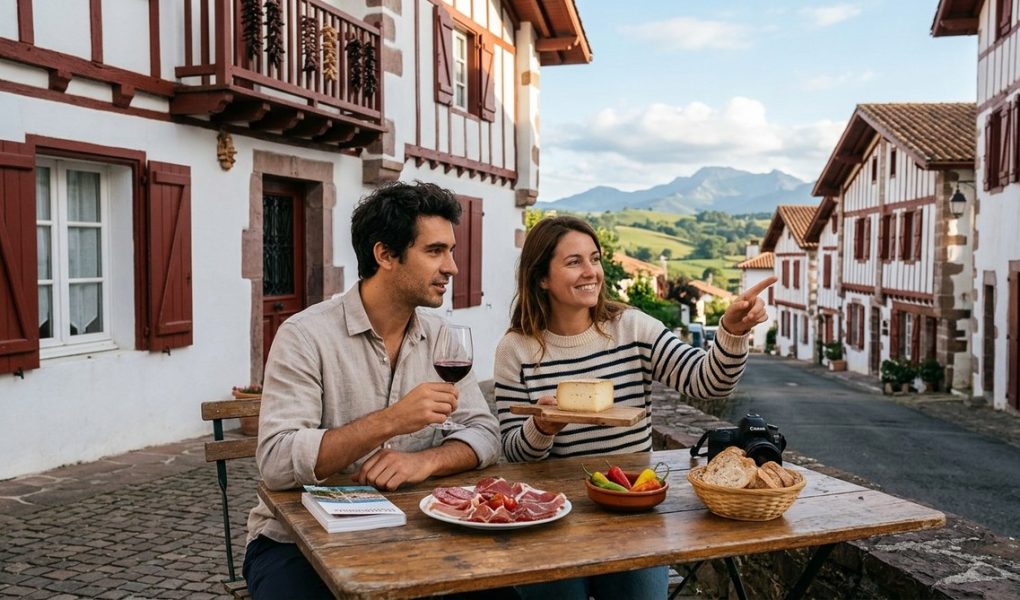
Take the bus from Saint-Jean-de-Luz to Espelette. This village is famous for its red peppers, which hang in garlands from every balcony and window. The drying season runs from late summer through fall, so if you visit in September or October, the entire town looks like a festival.
Walk the main street and visit the pepper shops. You can buy the powder, the preserves, and the dried whole peppers. Have lunch at a small restaurant that serves ttoro, a Basque fish stew that uses the pepper as its backbone. The heat is gentle, more aromatic than spicy.
Day 6: Hike the Coastal Path or Visit Sare
You have two excellent options for today. Choose based on your energy level.
Option one is the coastal path from Saint-Jean-de-Luz to Hendaye. This is a five-mile walk along the cliffs with views of the Atlantic and the Spanish coast. Pack a picnic and stop at the beach in Hendaye before taking the train back.
Option two is a trip to Sare, a village in the foothills of the Pyrenees. Take the bus from Saint-Jean-de-Luz. Sare is known for its prehistoric caves and its traditional Basque houses with their distinctive red shutters. Visit the caves in the morning and then have lunch at a farmhouse restaurant that serves lamb cooked over an open fire.
Day 7: A Cooking Class and a Final Feast
Book a morning cooking class with a local chef. Several operate out of Saint-Jean-de-Luz and the surrounding villages. You will learn to make piperade (the Basque version of ratatouille), a proper tortilla de bacalao, and perhaps a gâteau basque for dessert.
Spend your last afternoon at the market in Saint-Jean-de-Luz. Buy the things you cannot find at home: a jar of piment d’Espelette, a piece of Ossau-Iraty cheese, a bottle of Irouléguy wine. Have one final pintxos crawl along the Rue Gambetta.
What to Eat: A Basque Food Primer
The food in this region is distinct from the rest of France. It has more in common with the Spanish Basque Country across the border. Here is what you need to know.
| Dish | What It Is | When to Eat It |
|---|---|---|
| Pintxos | Small snacks on bread, held together with a toothpick | Lunch or early evening |
| Piperade | Scrambled eggs with peppers, onions, and tomatoes | Breakfast or lunch |
| Axoa | Veal or tuna stew with peppers | Lunch |
| Ttoro | Fish stew with piment d’Espelette | Dinner |
| Gâteau Basque | Cake filled with cherry jam or pastry cream | Dessert or with coffee |
| Bayonne Ham | Cured ham, similar to prosciutto | Any time, with bread |
| Ossau-Iraty | Sheep’s milk cheese | After dinner or on a picnic |
| Txakoli | Slightly sparkling white wine | With pintxos |
| Irouléguy | Red wine from the Pyrenees foothills | With meat dishes |
Local advice: Do not order a “pintxo” and expect a single plate. The custom is to go to the bar, look at what is laid out, and point at what you want. The bartender will give you a small plate and a toothpick. You eat standing up. You pay by the toothpick at the end. This is the most civilized way to eat dinner I have ever encountered.
How to Get Around Without a Car
This itinerary works best if you rely on public transportation. Here is the practical process.
- Take the train from Biarritz to Bayonne (10 minutes) or Saint-Jean-de-Luz (15 minutes). The TER trains run hourly.
- Use the bus network (Hegobus) to reach villages like Espelette and Sare. The schedules are posted at the tourist offices.
- Walk everywhere else. The coastal towns are small and pedestrian-friendly.
- If you must rent a car for a day, do it from the Saint-Jean-de-Luz station. Book in advance.
Where to Stay
For Biarritz, look for a hotel or apartment near the Grande Plage or the Port Vieux. You want to be able to walk to the beach and the pintxos bars. For Saint-Jean-de-Luz, stay in the old town near the Rue de la République. The proximity to the market and the port makes everything easy.
If you want a splurge, book a room at one of the small hotels in Ciboure. The views of Saint-Jean-de-Luz across the harbor are worth the premium.
When to Visit
The best time for this French Basque Country itinerary is May through June or September through October. July and August are crowded and expensive. The water is warmest in September, and the peppers are drying on the balconies in Espelette. Spring brings green hills and wildflowers. Fall brings the harvest and the food festivals.
The Art of Doing Nothing
The hardest part of slow travel is giving yourself permission to skip things. You will not see every village. You will not eat at every recommended restaurant. You will miss the cave paintings in Sare if the bus schedule does not cooperate. That is fine.
Sit on a bench in the Place Louis XIV in Saint-Jean-de-Luz and watch the children chase pigeons. Order a coffee and stay for an hour. Walk down to the port and watch the boats come in. These moments are the real souvenirs.
Why This Region Stays With You
The French Basque Country does not try to impress you. It does not need to. The food is honest, the landscape is dramatic, and the culture is proud without being performative. You will leave with a jar of pepper powder in your suitcase and a new understanding of what a vacation can feel like when you stop racing through it.
If this style of travel resonates with you, you might also enjoy weekend escapes that feel like week-long vacations or our guide to living like a local with a 30-day slow travel approach. For another food-focused journey, read about how to plan an entire trip around a single dish.
Pack light. Bring an appetite. Leave your schedule at home.