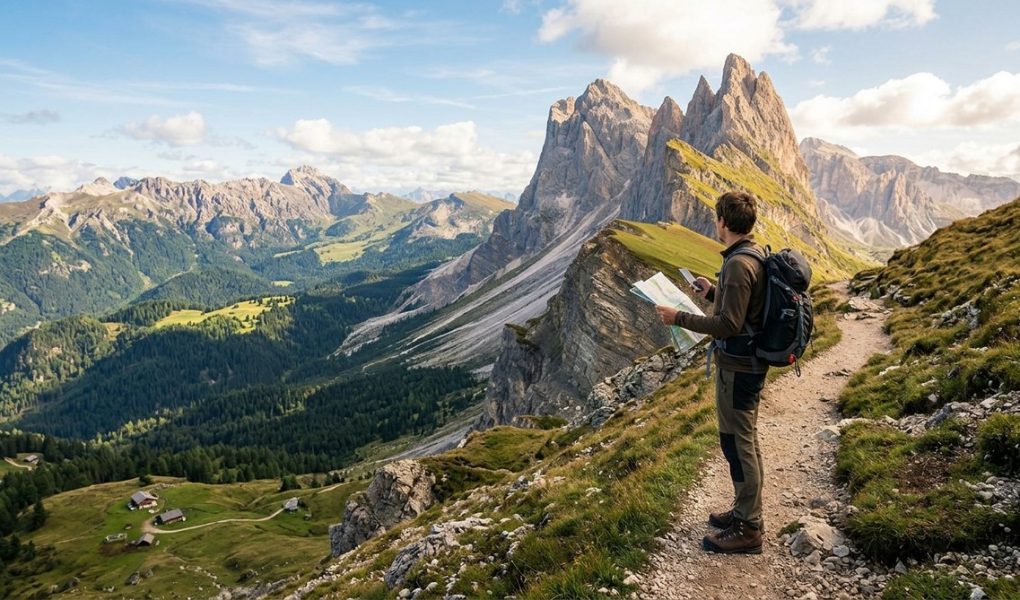
The Dolomites rise like pale cathedrals against a sky so blue it seems unreal. You have seen the photos: jagged peaks, emerald valleys, alpine meadows dusted with wildflowers. But the reality for most visitors is different. They find themselves shuffling behind a line of selfie sticks on the Alta Via 1, fighting for a table at a crowded rifugio, or listening to a dozen conversations in English where they expected only the sound of wind. That is the Dolomites of Instagram. It is not the Dolomites you want.
You want silence. You want the moment when the trail narrows and the group ahead turns right while you turn left. You want a 9-day Dolomites hiking itinerary that feels like a private showing of the world’s most dramatic mountain theater. And the good news? It exists. You just need to know where to look.
This 9-day Dolomites hiking itinerary sends you deep into the Unesco World Heritage region while actively sidestepping the crowded tourist corridors. You will hike lesser-known trails, sleep in family-run rifugi, eat where locals eat, and finish each day with a sense of discovery. No bus convoys. No queuing for viewpoints. Just you, the mountains, and the quiet hum of adventure.
Why a 9-Day Itinerary Hits the Sweet Spot
Most hikers visit the Dolomites for three or four days. They hit the three most famous rifugi, snap the same photos, and leave thinking they have seen it all. But the Dolomites are vast. Nine days gives you time to move between valleys, to cover ground without rushing, and to build a rhythm that lets you adapt to weather, energy levels, and spontaneous detours.
A 9-day Dolomites hiking itinerary also allows you to stay in less touristy base towns. Instead of fighting for a hotel in Cortina (where prices rival Manhattan), you can base yourself in villages like San Cassiano, Colfosco, or Laggio di Cadore. These places offer direct access to excellent trails with a fraction of the foot traffic.
Choosing Your Base: The Art of Avoiding Tourist Traps
The single most effective strategy for a crowd-free trip is where you choose to sleep each night. Here is how to think about it:
- Skip Cortina d’Ampezzo as your primary base. It is expensive and packed.
- Use Val Gardena as your hub for the first half. Towns like Selva and Ortisei are connected by lifts but the trails radiating east stay quiet.
- Move to Alta Badia for days 4 through 7. San Cassiano and Colfosco have a more relaxed feel and access to the hidden Fanes-Senes-Braies Natural Park.
- End in the Sexten Dolomites. The Val Fiscalina trailhead is a gateway to the Tre Cime with far fewer people than the main rifugio loop.
This geographic spread means you never stay in one place long enough to get bored, and each night brings a new set of local restaurants and mountain views.
Day-by-Day Insights for Your Crowd-Free 9-Day Dolomites Hiking Itinerary
Rather than a rigid day-by-day schedule (which never survives first contact with a thunderstorm), here is a flexible framework that hits the best crowd-free sections. You can arrange these blocks in any order based on weather and fitness.
Block 1: Val Gardena Hidden Trails (Days 1-3)
Start in Selva. On day one, take the Dantercepies gondola early morning (first car, before 8 a.m.) and hike the Cir ridge toward Piz Boe. Most groups take the lift and walk directly to the summit. Instead, traverse the ridge southeast from the top of the lift to Passo Pordoi. The trail is rugged, barely used, and offers 360-degree views that belong on a postcard.
For day two, skip the Seceda ridgeline (which is now a social media circus) and hike the Val di Fassa side of Sella Pass. The trail from Passo Sella to the Rifugio Friedrich August is a quiet gem. You will walk through limestone canyons and past old wartime tunnels.
Day three should be a rest or shorter walk. The Val Duron trail is a gentle 8-mile loop with alpine huts that serve handmade pasta and barley soup. You will see a handful of other hikers, not a hundred.
Block 2: Alta Badia and the Fanes Plateau (Days 4-7)
Transfer to San Cassiano. The Fanes plateau is the most magical landscape in the Dolomites and also the most underrated. Most tourists stick to the main trail that leads to the famous Lago di Braies. You can avoid that entirely.
On day four, hike from San Cassiano up to Rifugio Fanes via the Vallon de Fanes trail. This route passes through a lunar landscape of eroded rock and ancient larch forests. You will feel like you stepped into a fantasy novel.
Day five is a long traverse from Rifugio Fanes to Rifugio Averau via a hidden pass called Sentiero delle Giazzere. This is a technical but doable trail with steel cables in a few places. The reward? Averau has some of the best food in the entire range (try the venison stew).
Day six: rest in San Cassiano or take a short walk to the Gardenacia plateau. There is a via ferrata route called Sciatori that is almost never crowded. Rent a helmet and harness from the local shop.
Day seven: hike the Armentarola valley toward Passo Falzarego. This valley is a natural corridor with fewer people because it requires a longer approach. You will pass old mule tracks and abandoned barracks from World War I.
Block 3: Sexten Dolomites (Days 8-9)
A short bus or car transfer to the village of Sesto (Sexten). This area is a favorite among German and Italian hikers but relatively unknown to American visitors. The Val Fiscalina trailhead leads into the heart of the Tre Cime di Lavaredo but from a different angle. Instead of the crowded loop, hike toward the Forcella del Ghiacciaio pass. From there, you can see the famous three peaks without the crowds.
On your last day, take an easy hike to the Rifugio Locatelli but arrive by 7:30 a.m. The early light paints the Tre Cime pink, and you will have the viewpoint mostly to yourself. By 9:30 the buses start arriving.
How to Avoid Crowds on the Trail: A Comparison
Here is a table that contrasts common crowded choices with smarter alternatives.
| Common Mistake | Why It Is Crowded | Smarter Alternative |
|---|---|---|
| Hiking the Alta Via 1 main route in July | It is the most famous multi-day route | Use sections of Alta Via 2 or create your own link-up using less-known rifugi |
| Taking the lift to Seceda at 9 a.m. | Everyone has the same idea | Go at 7 a.m. or hike up from Ortisei (adds 90 minutes but you pass the crowds) |
| Staying overnight in Cortina | It is the only town many guidebooks mention | Base yourself in Villabassa or Dobbiaco for same access at half the price |
| Eating lunch at Rifugio Lagazuoi | It sits right at the top of a cable car | Walk 20 minutes to Rifugio Averau instead |
| Photographing Lago di Braies in the afternoon | Tour buses arrive constantly | Visit in the last hour before sunset (less crowded, better light) |
Insider Tips for a Seamless 9-Day Dolomites Hiking Adventure
These four steps will make your trip smoother than most.
-
Book your rifugi at least 60 days in advance. The popular huts fill up by April for summer. Use the official website rifugi.com or check each rifugio’s direct booking system. If a hut is full, ask about emergency beds (often reserved for walk-ins but not guaranteed).
-
Learn a few words of Ladin. The local language is not Italian or German, but Ladin. A simple “Bondi” (hello) and “Grazie” will earn you genuine smiles. It signals respect for the culture, which often gets overlooked.
-
Start every hike by 7 a.m. The most crowded period is between 10 a.m. and 2 p.m. Starting early also means you finish before afternoon thunderstorms, which are common in July and August.
-
Use public transport where possible. The Dolomiti Bus network covers most valleys. You can get from San Cassiano to Sesto with two transfers. It takes longer than driving but you avoid the nightmare of finding parking at popular trailheads.
What to Pack for a 9-Day Dolomites Hiking Trip
Pack light but prepare for variable conditions. Here is a minimal list:
- Hiking boots with stiff soles (needed for scree and via ferrata sections)
- Three pairs of merino wool socks
- Convertible hiking pants (zip-off legs)
- Lightweight down jacket (even in summer, temperatures at 2,500 meters can drop to 40 degrees Fahrenheit)
- Rain jacket and rain pants (not just a shell; it must be waterproof)
- Sun hat and sunscreen (the sun is intense at altitude)
- Headlamp (some rifugi have limited evening light, and you may need it for early starts)
- 1.5-liter water bottle or hydration bladder (plus purification tablets if you plan to fill from streams)
- Power bank (outlets in rifugi are limited)
- First-aid kit with blister care (Compeed patches are lifesavers)
“I have hiked the Dolomites for 15 years,” says Luca, a mountain guide from Cortina. “The biggest mistake first-timers make is trying to see too much. Pick one valley, stay three nights, and walk every side trail. That is how you find the quiet corners.” His advice holds true for any 9-day Dolomites hiking itinerary: depth beats breadth.
Putting It All Together
A 9-day Dolomites hiking itinerary that avoids tourist traps is not about secret trails that no one knows. It is about timing, base selection, and the willingness to walk a little farther than the crowd. You do not need a guide or a fancy map. You need a plan that prioritizes quiet over convenience.
Start early. Sleep in rifugi that require a hike to reach. Eat speck and canederli in a wooden hut where the owner remembers your name. When you leave, you will take home something better than photos. You will take home the memory of a mountain range that felt like yours alone.
If you love this kind of purposeful, crowd-free travel, you might also enjoy our guide to 15 Underrated European Cities That Rival Paris and Rome, and for more extended mountain adventures, check out The Ultimate Guide to Multi-Day Hiking Trails That Changed My Perspective on Travel.
Now go book that flight to Venice. The trails are waiting, and they are quieter than you think.