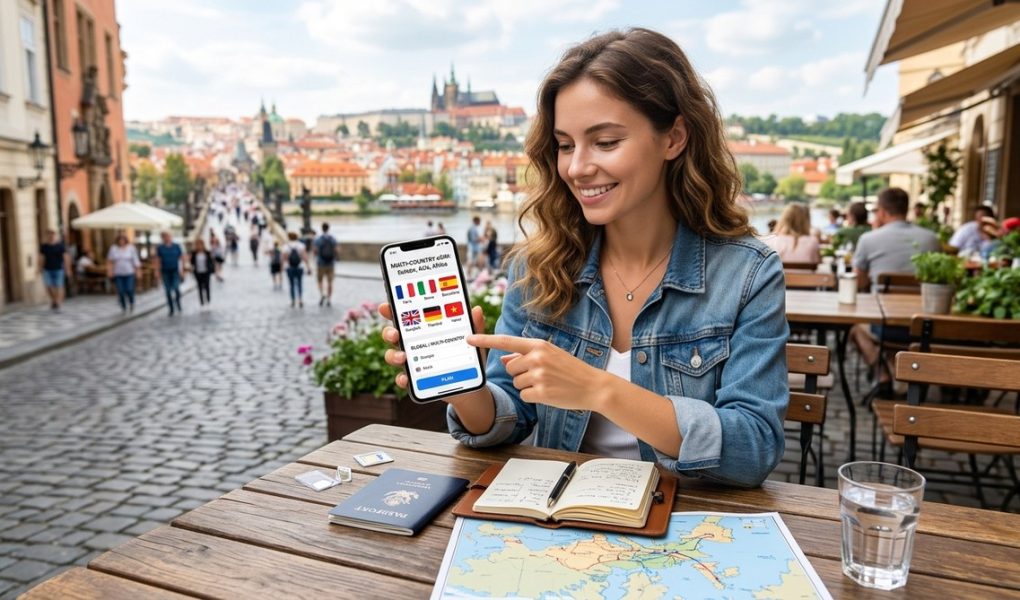
You are standing in a train station in Amsterdam. In three hours you will be in Brussels. Tomorrow you cross into Germany. Your phone is your map, your ticket, your camera, and your connection home. If it does not work, your trip stalls. Picking the best eSIM for multi country travel is not about finding the cheapest SIM card. It is about building a connectivity system that follows you across borders without friction, without surprise fees, and without that moment of panic when you realize you have no signal.
The best eSIM for multi country travel depends on your route, not your phone. If you visit three countries in one region, a regional plan usually beats juggling separate local eSIMs. If you cross continents, a global plan with generous data limits saves headaches. Always check device compatibility, activation timing, and fair-use policies before you buy. Carry a backup eSIM from a different provider for critical trips.
Why a Single Country eSIM Can Let You Down
A single-country eSIM can work well for a long weekend in one place, but it may not provide data after you cross into a country that is not listed in the plan. On a multi-country trip, separate country plans mean managing multiple installations, app logins, and data balances. That can work, but it adds friction to travel days.
For example, if you fly into Singapore and then continue to Thailand, you could buy separate Singapore travel eSIMs and a plan for Thailand. That works, but you will need to switch profiles on your phone each time you land. If you instead choose a regional Southeast Asia plan, your eSIM stays active across both countries without manual switching.
The same logic applies to a trip that starts in Hong Kong and moves into mainland China. You could pick up Hong Kong travel eSIMs for the first leg, but then you need a separate solution for the rest of your itinerary. A regional or global plan eliminates that gap.
Regional Plans vs. Global Plans vs. Country Plans
The first decision you need to make is which type of coverage matches your itinerary. Here is how they stack up.
| Plan Type | Best For | Typical Use Case |
|---|---|---|
| Country plan | Single destination trips | Weekend in one city or a week in one country |
| Regional plan | Multi-country trips within one continent | Europe rail trip, Southeast Asia backpacking |
| Global plan | Cross-continent or long-haul travel | Asia to Europe, South America to Africa |
A regional plan is often the best eSIM for multi country travel when your route stays inside one geographic area. If you are visiting France, Spain, and Italy, a Europe regional plan activates automatically in all three. You do not need to buy a new eSIM in each capital.
Global plans cover broader destination lists, but availability, network access, and performance can vary by country. If you are travelling between continents, compare the live country list carefully. For travellers who prefer to manage one plan, global travel eSIM plans offer a practical option to review.
Data Allowance and Validity Periods
Data limits matter more on a multi-country trip than on a single-city visit. You will use your phone for maps, translation apps, ride-hailing services, video calls, and social media. A 1 GB plan that lasts seven days might vanish before you leave the first country.
Consider these factors when evaluating data allowances:
- How many hours per day will you actively use data?
- Do you plan to stream music or video on trains or in hotels?
- Will you use your phone as a hotspot for a laptop?
- How long is the total trip?
Validity periods also vary. Some eSIMs activate the moment you scan the QR code. Others activate only when you connect to a local network in the destination country. If you buy your eSIM a week before departure, a plan with activation-on-arrival gives you the full validity window starting from day one of your trip.
Activation Timing and the Setup Process
Getting your eSIM working should be simple. Most providers follow a similar process.
- Purchase the eSIM online before your trip. You will receive a QR code or an activation code by email.
- Install the eSIM profile on your phone. On an iPhone, go to Settings > Cellular and scan the QR code. On Android, go to Settings > Network > Add eSIM.
- Activate the plan according to the provider’s instructions. Some plans activate immediately. Others activate when your phone connects to a supported network in the destination country.
- Set the eSIM as your primary data line. Keep your home SIM active for calls and SMS if your phone supports dual SIM.
The exact steps vary by device and provider. Test the installation before you leave home if possible. That way you are not troubleshooting a QR code in an airport lobby.
Hotspot and Fair-Use Checks
Some eSIM providers include hotspot tethering in their plans. Others restrict it. If you plan to share your connection with a laptop or tablet, confirm that hotspot use is allowed. A plan that blocks tethering will not work for remote work sessions or uploading photos from a camera.
Fair-use policies are another hidden detail. Most regional and global plans advertise a certain data cap, but the fine print may include a “fair use” clause that reduces speeds after you use a portion of your data in a short period. This is common on unlimited data plans. If you stream video every night, you might hit that throttle point halfway through your trip.
Look for plans that specify a clear data allowance without ambiguous fair-use language. If a plan says “unlimited” but includes a fair-use cap, treat it as a limited plan with extra flexibility.
Device Compatibility and Keeping Your Home Number
Not every phone supports eSIM. Before you buy, check that your device is unlocked and eSIM-compatible. Most modern smartphones from 2019 onward work, but older models and some carrier-locked phones do not.
If your phone supports dual SIM, you can keep your home number active for calls and SMS while using the eSIM for data. This is useful for receiving two-factor authentication codes from your bank or for keeping your home number reachable. On an iPhone with an eSIM and a physical SIM, you can set the eSIM as the default for data and keep the physical SIM for voice.
If your phone does not support dual SIM, you have two choices. You can remove your home SIM and rely entirely on the eSIM, or you can carry a second phone or a portable hotspot as a backup.
Backup Planning for Critical Trips
A single eSIM is a single point of failure. If the provider’s network goes down in a specific country, or if your eSIM profile corrupts, you lose connectivity. For important trips where you need to stay reachable, carry a backup.
Your backup can be a second eSIM from a different provider on the same phone. Most phones allow multiple eSIM profiles, though only one can be active at a time. If your primary eSIM fails, switch to the backup profile.
Alternatively, carry a physical SIM from a local carrier as a fallback. In many countries, you can buy a prepaid physical SIM at the airport for a low cost. It is not as convenient as an eSIM, but it works if your eSIM does not.
For travelers who want to understand the local options before they arrive, reading a city-specific guide can help. The Singapore eSIM guide and Thailand eSIM guide break down what to expect in those markets. Similarly, the New York eSIM guide and Boston eSIM guide cover domestic US travel, while the Berlin eSIM guide is useful for a German stopover.
A backup is useful only when it is genuinely independent. Before relying on a second eSIM, check whether it uses a different provider and whether your phone can store or enable both profiles as needed.
Building Your Decision Framework
When you sit down to choose the best eSIM for multi country travel, work through these questions in order.
- Where are you going? List every country on your itinerary.
- How long will you stay in each country? If you spend more than a week in one place, a country plan for that leg plus a regional plan for the rest may be optimal.
- What is your data habit? Heavy users need larger allowances or plans with clear unlimited terms.
- Do you need hotspot capability? If yes, confirm it in the plan details.
- What is your backup strategy? Decide before you leave.
A table can help you compare your options side by side.
| Your Itinerary | Suggested Approach | Why |
|---|---|---|
| 3 countries in Western Europe | Regional Europe plan | One plan, automatic switching |
| 2 countries in Southeast Asia plus a stop in Japan | Compare a regional plan with separate country plans | Confirm that all three countries appear in the live destination list |
| 5 countries across Europe and North Africa | Compare global and regional combinations | Balance the number of profiles against allowance, validity, and support |
| 1 country with a short border crossing | Compare a regional plan with two country plans | Do not assume a country plan includes the neighbouring destination |
When to Choose a Global Plan
A global plan makes sense when your route does not fit neatly into one region. If you start in Europe, spend a week in the Middle East, and finish in Southeast Asia, a global plan simplifies everything. You buy once, install once, and your data works across all three regions.
Global plans can be useful for travellers who make last-minute itinerary changes, but the word “global” does not prove that every country is included. Check the live destination list before changing your route. Regional plans cover only their stated geography and country list.
The trade-off is that network access and performance can differ by country, location, device, plan, and local conditions. Treat broad destination coverage and actual connection quality as separate questions.
Matching Your eSIM to Your Travel Style
Your travel style influences which plan fits best.
If you are a slow traveller spending two weeks in each country, you might prefer country-specific plans. Compare their allowances, validity, hotspot terms, and final prices with a regional option before deciding.
If you move every few days, a regional or global plan saves you the hassle of buying and installing a new eSIM at every stop. You land, your phone connects, and you move on.
For digital nomads who work while travelling, the fair-use policy and hotspot rules matter as much as the headline allowance. Read those terms before relying on a plan for video calls or file uploads, and consider an independently sourced backup for critical work.
A Practical Example Across Three Countries
Imagine a two-week trip that starts in Singapore, moves to Thailand, and ends in Hong Kong. You could buy separate eSIMs for each country. That means three purchases, three installations, and three activations.
Or you could compare a regional Southeast Asia plan that explicitly lists Singapore and Thailand with a separate Hong Kong plan for the final leg. That would involve two purchases instead of three.
Or you could buy one global plan that covers all three. That is one purchase, one installation, and zero switching.
The best eSIM for multi country travel in this scenario depends on your tolerance for setup time. If you want the simplest path, go global. If you want to optimize data for each country, go regional with a country add-on.
Final Thoughts on Staying Connected Across Borders
Choosing the best eSIM for multi country travel comes down to matching the plan to your route, not to your phone. A regional plan covers most multi-country trips within one continent. A global plan works for cross-continent travel. Country plans are best for long stays in single destinations.
Check device compatibility before you buy. Understand activation timing so your data starts when you need it. Confirm hotspot and fair-use policies if they matter to your usage. And always carry a backup for trips where staying connected is critical.
The right eSIM does not just save you money. It saves you the frustration of hunting for a SIM card shop in a foreign airport or explaining to a hotel front desk why your phone does not work. Set it up before you leave, test it at home, and then forget about it. Your phone will connect automatically as you move from country to country, and you can focus on what you came for: the trip itself.
For more inspiration on where to take that trip, read about 15 underrated European cities that rival Paris and Rome or plan a 10-day Southeast Asia temple trail without the tourist crowds. Your connectivity is the foundation. The adventure is what you build on top of it.