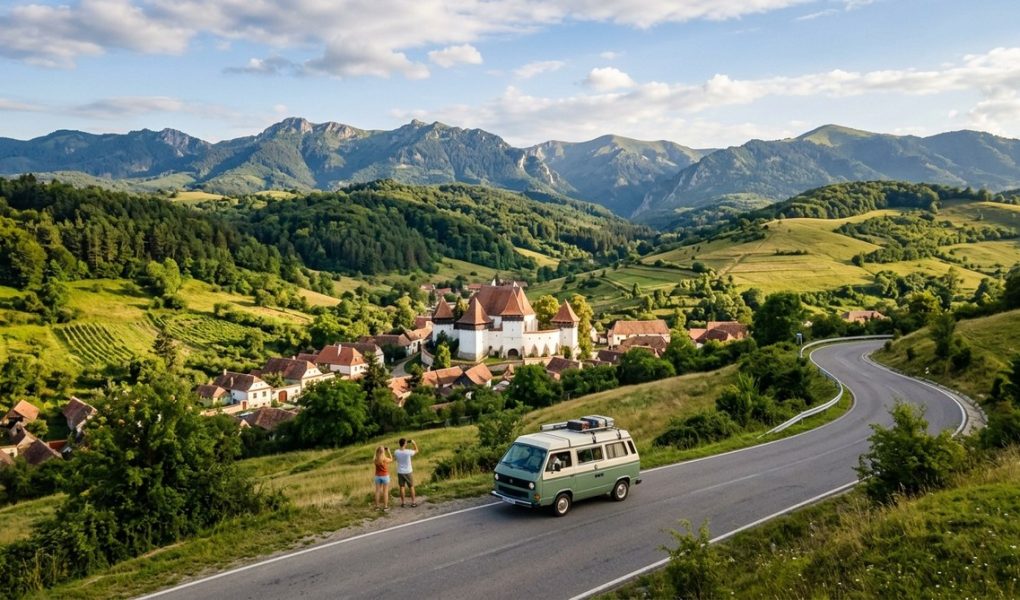
Most travelers arrive in Transylvania with one name on their lips. They want castles, fog, and a count with a cape. But the real Transylvania is far stranger and more beautiful than any gothic novel. This is a land of Saxon fortified churches that have stood for 800 years, of shepherds moving flocks across alpine meadows, of painted monasteries where the colors still blaze after five centuries. You can taste it in the sour cherry soup and the smoky palinca shared at a farmhouse table. You can hear it in the clatter of horse carts on cobblestone lanes and the deep bells of Orthodox cathedrals. This 7-day road trip is designed for the traveler who wants to meet Transylvania on its own terms, not through the lens of Bram Stoker.
This 7-day Transylvania road trip itinerary circles from Cluj-Napoca through the Apuseni Mountains, Maramures, Bucovina, and Sighisoara before ending in Brasov. You will visit UNESCO fortified churches, hike in the Carpathians, eat with local families, and see painted monasteries. You will not visit Bran Castle. The real Transylvania is richer than any vampire story.
Why Transylvania deserves more than vampire lore
When you tell friends you are going to Transylvania, they make fang jokes. It gets old by day two. But here is the truth: the Dracula myth is a tourist invention that has little to do with the real region. The historical Vlad Tepes, who inspired the character, was a 15th-century ruler with a complicated reputation. He spent almost no time in the castles tourists flock to see.
What Transylvania actually offers is a cultural crossroads unlike anywhere in Europe. Saxon Germans built fortified churches on hilltops starting in the 1200s. Romanian Orthodox monasteries preserve frescoes that belong on the short list of world art treasures. Hungarian nobles left behind Baroque palaces and thermal baths. And the Carpathian Mountains remain one of the last great wilderness areas on the continent, home to bears, wolves, and lynx.
If you want an authentic experience, skip Bran Castle entirely. It is crowded, overpriced, and mostly empty of historical substance. Instead, this itinerary sends you to places like the Biertan fortified church, the Merry Cemetery of Sapanta, and the Painted Monasteries of Bucovina. Each of these locations tells a truer story about the people who have lived here for centuries.
Your 7-day Transylvania road trip itinerary
This loop starts and ends in Cluj-Napoca, which has excellent flight connections from major European hubs. You can also begin from Bucharest if you prefer, but the route reads more naturally from Cluj. The total driving time is manageable: about 12 to 14 hours spread across the week, with plenty of stops.
Day 1: Cluj-Napoca and the Apuseni gateway
Land in Cluj and pick up your rental car. Spend the morning wandering the city’s main square, Piata Unirii. See St. Michael’s Church and the National Museum of Transylvanian History. Cluj has a young energy thanks to its large student population. Coffee shops and bookstores line the side streets.
In the afternoon, drive one hour west to the Apuseni Mountains. This is limestone karst country, full of caves and gorges. Visit the Scarisoara Ice Cave, which holds a glacier that is more than 3,000 years old. The cave stays around 32 degrees Fahrenheit year round, so bring a jacket even in summer.
Stay overnight in a guesthouse in the village of Garda de Sus. Many local families offer home-cooked dinners. Accept the invitation.
Day 2: Maramures wooden churches and the Merry Cemetery
Today you drive north toward Maramures, about three hours from Garda de Sus. This region is famous for its wooden churches with tall spires and shingled roofs. Eight of them are UNESCO World Heritage sites.
Stop in the town of Sighetu Marmatiei to see the Memorial of the Victims of Communism. It is a sobering museum housed in a former prison, but it offers essential context for understanding 20th-century Romania.
Finish the day at the Merry Cemetery in Sapanta. The colorful tombstones feature playful epitaphs written in the first person. One reads: “Under this heavy cross / Lies my mother-in-law. / If she had lived three more days, / I would be lying here, and she would be reading this.” It is unlike any cemetery you have ever visited.
Stay in a traditional Maramures wooden house guesthouse. Your host will likely show you the family’s woven textiles and carved wooden gates.
Day 3: The Painted Monasteries of Bucovina
Drive east for about three hours into Bucovina. This region is home to the world-famous painted monasteries, and they are worth every mile of the drive.
The five key monasteries are Voronet, Humor, Moldovita, Sucevita, and Arbore. Each exterior wall is covered in frescoes dating from the 15th and 16th centuries. The dominant color is a deep blue so distinctive that art historians call it “Voronet blue.” The paintings depict biblical scenes designed to teach the faith to a largely illiterate population.
If you can only visit two, make them Voronet and Sucevita. Voronet has the most famous frescoes, and Sucevita is the largest and best preserved.
Spend the night in the town of Gura Humorului. Try the local specialty: a sour soup called ciorba de fasole, made with beans and smoked pork.
Day 4: Sighisoara and the Saxon fortified churches
Drive south for about four hours toward Sighisoara. This is the longest driving day, but the landscape shifts from mountains to rolling hills and you will pass through several small Saxon villages worth a stop.
Sighisoara is a UNESCO World Heritage site and one of the best-preserved medieval towns in Europe. The citadel sits on a hill with cobblestone streets, a covered stairway, and a 14th-century clock tower. Yes, Vlad Tepes was born here. No, you do not need to make it the focus of your visit. Instead, climb the tower for views of the surrounding countryside and have lunch at a restaurant serving Saxon cuisine, like pork roast with sauerkraut and polenta.
On the way into town, stop at the Biertan fortified church. It is one of the most impressive in the region, with three concentric defensive walls and a 100-foot deep well.
Stay inside the Sighisoara citadel. The hotels are historic and atmospheric.
Day 5: Brasov and the Carpathian wilderness
Drive two hours southeast to Brasov, the largest city in Transylvania and the unofficial capital of the Saxon region. The city center is dominated by the Black Church, a Gothic Lutheran cathedral that takes its name from smoke damage from the 1689 fire.
Take the cable car up Tampa Mountain for a view of the entire city. Walk the narrow Rope Street, one of the narrowest streets in Europe. But do not spend all day in town. The real draw is the surrounding wilderness.
In the afternoon, drive 30 minutes to the Piatra Craiului National Park. This is prime hiking territory. A moderate trail follows the ridge line with views of the Carpathians. With luck, you might spot chamois or even a brown bear from a safe distance. Local guides can take you on wildlife-watching walks at dusk.
Stay in a guesthouse in the village of Zarnesti, just outside the park. Several offer farm-to-table dinners with ingredients from their own gardens.
Day 6: Rasnov fortress and traditional village life
Today is for slowing down. Drive 20 minutes from Brasov to the Rasnov fortress, a peasant citadel that protected villagers from invaders. Unlike Bran Castle, this one feels authentic. You can wander the ruins and imagine what daily life looked like for the farmers who took shelter here.
Afterward, drive deeper into the countryside to a village like Viscri or Crit. These Saxon villages have changed little in 200 years. Many travelers compare them to a living museum. Walk the dirt lanes, watch craftspeople at work, and visit the local church.
In Crit, a small guesthouse run by a local family serves lunch by reservation. The meal is simple: homemade bread, cheese, vegetables, and grilled meat. It is the kind of meal you remember for years.
Return to Brasov for a second night, or stay in a village guesthouse if you prefer quiet.
Day 7: Return to Cluj via the Transylvanian Plateau
Your final day involves a four-hour drive back to Cluj, but the route is rewarding. Take the road through the Tarnava Mare region, which is dotted with Saxon fortified churches. Stop at the one in Valea Viilor or Mosna. Both are less visited than Biertan and offer a more solitary experience.
Arrive in Cluj with enough time to return your car and have a farewell dinner. Try the local craft beer scene. Several brewpubs near the main square serve excellent Romanian ales.
Practical tips for your Transylvania road trip
A good road trip depends on preparation. Here are the key things to know before you go.
| Category | Do This | Avoid This |
|---|---|---|
| Rental car | Book a car with GPS and a spare tire. Roads can be rough. | Renting a low-clearance sedan. You will want a compact SUV. |
| Navigation | Download offline maps. Cell service is unreliable in mountains. | Trusting GPS alone. Some rural roads are not well mapped. |
| Currency | Carry enough Romanian lei for rural areas. Card acceptance is limited. | Assuming you can pay with card everywhere. |
| Language | Learn a few Romanian phrases. “Multumesc” means thank you. | Expecting English fluency outside tourist zones. |
| Food | Eat at local markets and guesthouses. The food is fresh and authentic. | Eating at tourist-oriented restaurants in busy squares. |
| Timing | Start each day by 8 a.m. to maximize daylight. | Driving after dark. Animals on roads are a real hazard. |
| Accommodation | Book guesthouses in advance during summer and holidays. | Arriving without a reservation in July or August. |
“The best advice I give to visitors is to let go of the Dracula story on day one. It is like coming to New York and only looking for King Kong. Transylvania has layer after layer of history, and the real magic is in the small moments: a shepherd offering you fresh cheese, a grandmother showing you her loom, the sound of church bells across a valley at dusk.” — Andrei Popescu, local guide in Sibiu, Romania
How this road trip compares to the tourist version
Many travel companies offer “Dracula tours” that cram Bran Castle, Bucharest, and a few rushed stops into three days. You can see the difference clearly.
- Tourist approach: Three days, two castles, vampire merchandise, bus crowds.
- This itinerary: Seven days, eight UNESCO sites, local homestays, wilderness hiking.
- Cost comparison: The rushed tours often cost more per day than a self-driven trip.
- Authenticity level: Guesthouse meals and village walks create real connection.
This approach aligns with a style of travel that prioritizes understanding over checking boxes. If you enjoy that philosophy, you might also like our guide to https://touriosity.travel/why-the-faroe-islands-should-be-your-next-nordic-adventure/ for another destination that rewards depth over speed.
What to pack for a Transylvania road trip
Pack for variable weather and lots of walking.
- Layers are essential. Even summer evenings can dip into the 40s.
- Sturdy walking shoes for cobblestones and hiking trails.
- A rain jacket. Afternoon thunderstorms are common in the Carpathians.
- A headlamp for caves and evening walks.
- A reusable water bottle. Tap water is safe in most towns.
- A small Romanian phrasebook or a translation app.
Leave behind any expectations about Dracula. Bring curiosity instead.
The best times for this itinerary
Late spring through early fall offers the best conditions.
- May through June: Green hills, wildflowers, fewer tourists.
- July through August: Warm weather, busy at major sites, book early.
- September through October: Harvest season, golden light, excellent hiking.
- November through March: Cold, some guesthouses close, roads can be icy.
For first-time visitors, September is the sweet spot. The weather is mild, the crowds have thinned, and the autumn colors in the Carpathians are spectacular.
Why this trip changes how you see Romania
Every traveler I know who has done this loop comes back with the same reaction. They expected to find a theme park version of Transylvania. Instead, they found a place where history is still alive, where traditions are not performed for tourists but lived daily.
The Saxon fortified churches are not attractions. They are community gathering places that have anchored villages for 700 years. The painted monasteries are not museums. They are active places of worship where monks still chant and candles still burn. The Carpathian trails are not groomed park paths. They are routes used by shepherds for generations.
This kind of travel leaves a mark. It makes you think differently about what authenticity means.
If you are planning more trips that seek the real story behind the tourist narrative, take a look at https://touriosity.travel/how-to-explore-japan-beyond-tokyo-and-kyoto/ or Both guides follow the same principle: skip the obvious, find the genuine.
Your turn to plan this Transylvania road trip
You now have the route, the tips, and the context. What remains is booking the car, reserving the guesthouses, and getting on the plane.
Start with flights to Cluj-Napoca (airport code CLJ). Major airlines from New York, London, and other US hubs connect through Munich or Vienna. Rental cars are available at the airport. Book at least two months ahead for summer travel.
For guesthouses, look for properties on booking platforms that specifically mention “traditional” or “family-run.” Read recent reviews that mention food quality and hospitality. The best stays often have fewer than 10 rooms.
This 7-day Transylvania road trip itinerary is ready for you to adapt. Add a day in the mountains. Skip a village if you want more hiking. The structure is flexible. What matters is the approach: go slow, eat local, listen to the stories, and leave the vampire jokes behind. Transylvania has been waiting for you to see it clearly.