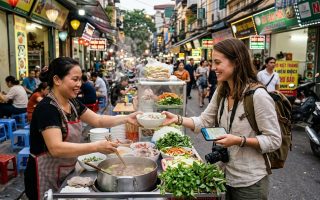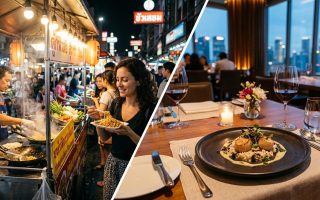
You step off the plane in a city where the alphabet looks like abstract art. The street food smells incredible, but the vendor does not speak English. Your stomach growls. Your confidence wavers. This is the moment every traveler fears, but it is also the moment where the best meals of your life begin. You do not need a phrasebook to eat well. You need a system.
Eating in a foreign country without the language is about preparation and observation, not fluency. Learn five to ten food-related words, use visual menus, and rely on translation apps for dietary needs. Trust street food lines, point politely, and accept that pointing is a universal language. The goal is connection through food, not perfect communication. Mistakes are part of the adventure.
The Prep Work That Pays Off
Before you leave home, spend thirty minutes on your phone. That investment will save you hours of confusion and help you avoid accidentally ordering a plate of raw sea urchin when you wanted grilled fish.
Start with a shortlist of survival words. You do not need to learn how to order a coffee. You need to know the words for chicken, fish, beef, pork, egg, rice, noodle, bread, and vegetable. Add the word for spicy if you have a low tolerance. Add the word for peanut if you have an allergy. Write these on a note in your phone or on a small card you keep in your pocket.
Download two or three translation apps before you go. Google Translate works for typed text and voice. DeepL is better for longer phrases. Papago is excellent for Korean, Japanese, and Chinese. Test them at home so you know how the camera translation feature works. That feature lets you point your phone at a menu and see the text change into English in real time. It is not perfect, but it is close enough.
Save photos of common dishes for the region you are visiting. If you are heading to Thailand, save a picture of pad thai, green curry, and mango sticky rice. If you are going to Morocco, save tagine, couscous, and pastilla. When you cannot read the menu, you can show the photo to the server and point.
Why learning basic phrases transforms your travel experience goes deeper into the specific words that open doors. For eating, those ten food words are your golden ticket.
The Pointing Method and Other Non-Verbal Hacks
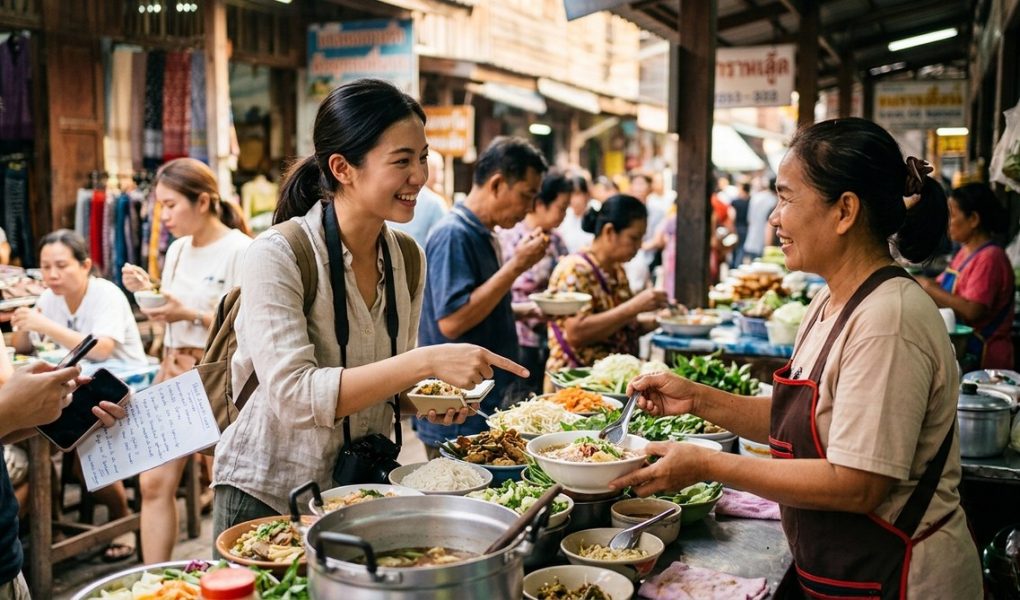
Pointing is not rude. It is practical. In most cultures, pointing at a menu item or at a dish on another table is perfectly acceptable. The trick is to do it with a smile and a nod.
Here is a simple process that works in almost any country:
-
Scan the room. Look at what other people are eating. If you see a bowl of something that looks good, walk over, smile, and point at their plate. Then point at yourself. They will understand. The server will bring you the same thing.
-
Use the display case. Many street stalls and casual restaurants have their ingredients or finished dishes on display. Walk up, point at what you want, and hold up the number of portions with your fingers. This works for skewers, pastries, dumplings, and grilled meats.
-
Carry a visual menu. Take photos of the dishes you want before you leave your hotel. Show the photo to the server. This is especially useful for breakfast when you are tired and hungry.
-
Learn the gesture for “enough.” In many countries, servers will keep bringing food until you stop them. Learn the local hand gesture for “stop” or “no more.” In Japan, waving your hand back and forth in front of your face means “no thank you.” In Italy, a slight head shake works.
-
Write numbers on a napkin. If you are at a market and need three of something, write “3” on a napkin and point. This avoids confusion with fingers, which mean different numbers in different cultures.
“The best meal I ever had was in a small town in Vietnam where nobody spoke a word of English. I pointed at a bowl of pho that a man was eating on a plastic stool. He smiled, nodded, and told the cook. Thirty minutes later, I had the best soup of my life. We communicated through smiles and nods. No words needed.” — Touriosity reader submission
What to Do When You Have Dietary Restrictions
This is the hardest scenario. If you have celiac disease, a nut allergy, or a severe intolerance, you cannot rely on pointing. You need clear, written communication.
Create a card in the local language before you travel. Write out your restriction in full sentences. Use a translation app and then ask a native speaker to review it. Do not trust machine translation alone for medical information. Print several copies and keep them in your wallet, your day bag, and your phone.
For gluten-free travelers, the phrase “no flour, no bread, no soy sauce” is essential in many Asian countries. Soy sauce contains wheat, and it is in almost everything. You need to be specific.
For dairy intolerance, learn the local word for milk, cheese, butter, and cream. In many parts of Asia, dairy is not common, so the risk is lower. In Europe, dairy is everywhere.
If you have a severe allergy, consider carrying a chef card that explains the severity in the local language. Some travelers also carry a medical alert bracelet with their allergies written in multiple languages. This is not overkill. It is safety.
The complete guide to street food safety for adventurous eaters covers how to assess hygiene and avoid common pitfalls while still eating like a local.
The Table of Techniques and Mistakes
Here is a breakdown of what works and what does not when you are trying to order food without speaking the language.
| Technique | How It Works | Common Mistake |
|---|---|---|
| Pointing at a dish on another table | Walk over, smile, point, then return to your seat | Pointing with a finger instead of an open hand in some Asian cultures |
| Using a translation app for menus | Open camera, scan menu, read translation | Expecting perfect accuracy on handwritten or faded menus |
| Carrying a photo of a dish | Show photo to server, nod when confirmed | Using a photo of a dish that is out of season or unavailable |
| Writing down numbers | Write “2” on a napkin, point at item | Assuming the vendor understands English numerals |
| Learning five food words | Practice pronunciation at home | Using the wrong tone in tonal languages like Thai or Vietnamese |
| Following the crowd | Eat where locals are lined up | Assuming a long line means good food (it could mean the only option) |
How to Navigate Markets and Street Stalls
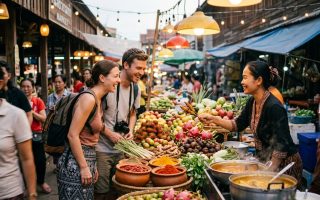
Markets are the easiest place to eat without a shared language. The food is visible. The prices are often posted. You can see exactly what you are getting before you commit.
Walk the entire market first. Do not buy from the first stall that looks good. See what is available. Notice which stalls have the longest lines of local people. That is your signal. Locals know where the food is fresh and safe.
When you find a stall, use this approach:
- Stand back and watch for a minute. See how the vendor works. See how customers order.
- When it is your turn, smile. Point at what you want. Hold up the number of fingers for quantity.
- If the vendor asks a question you do not understand, they are probably asking about spice level, sauce preference, or whether you want it to go. Nod and smile. You will get something. It will probably be good.
- Pay with small bills. Large bills are a hassle at street stalls. Keep a stack of small local currency in your pocket.
If you are unsure about a stall, look for these signs of a good vendor: they are busy, they handle food with gloves or tongs, they have a clean workspace, and they cook fresh batches rather than reheating old food.
Where locals actually eat: finding authentic food experiences in tourist-heavy cities will help you identify the real gems hidden in plain sight.
The Essential Tool Kit for Eating Without Words
Pack these items before your trip. They weigh almost nothing and will save you from awkward situations.
- A small notebook and pen. You can draw pictures, write numbers, or have the server write down the price.
- A phone with a good camera. Take photos of menus, receipts, and dishes you want to try later.
- A portable charger. Translation apps drain battery fast. You do not want your phone to die when you need to read a menu.
- A reusable bag. In many markets, vendors will hand you food in a plastic bag. Having your own bag makes carrying everything easier.
- A set of chopsticks or a spork. Some street stalls do not provide utensils. Having your own means you can eat anywhere.
What to Do When Things Go Wrong
You will make mistakes. You will accidentally order something you do not like. That is part of the experience. Here is how to handle the most common problems.
You ordered something too spicy. Do not drink water. It spreads the capsaicin. Drink milk, eat yogurt, or chew on bread. In Thai restaurants, ask for a side of sticky rice. In Indian restaurants, order raita, which is a yogurt side dish.
You ordered something you are allergic to. This is serious. If you have a reaction, seek medical help immediately. Carry antihistamines if you have mild allergies. For severe allergies, carry an epinephrine auto-injector and a medical card in the local language.
You do not like the dish. Eat what you can and leave the rest. Do not make a face or complain loudly. In many cultures, wasting food is less rude than criticizing the cook. Simply say thank you, pay, and move on.
You cannot figure out how to eat the dish. Watch the people around you. See how they hold the utensils, how they dip the sauce, how they assemble the wrap. Copy them. If you are still stuck, ask a neighboring diner by pointing at their hands and smiling.
The Best Apps for Eating Abroad in 2026
Technology has made eating without a shared language much easier. These apps are worth downloading before your trip.
- Google Translate — Camera translation for menus. Voice translation for conversations. Download the language pack for offline use if you will be in areas with poor cell service.
- Papago — Better than Google Translate for Korean, Japanese, Chinese, and Vietnamese. The camera feature is especially accurate for Asian scripts.
- HappyCow — If you are vegetarian or vegan, this app shows plant-friendly restaurants worldwide. It includes user reviews and notes on which dishes are safe.
- OpenTable or TheFork — Book reservations without speaking to anyone. The app handles the communication. Just show up at your booked time.
- Maps.me — Download offline maps of the area. Mark the restaurants you want to visit. When you are walking around, you can see what is nearby without needing data.
7 essential apps that transform how you navigate foreign cities like a local has more recommendations for the full travel tech stack.
How to Handle the Check and Tipping
In many countries, the server will bring the bill to your table. You do not need to ask for it. If they do not, make eye contact and make a writing gesture in the air. That is universal.
For tipping, research the local customs before you go. In Japan, tipping is not practiced and can be confusing. In the United States, it is expected. In Europe, service is often included. In many parts of Southeast Asia, rounding up the bill is sufficient.
If you are unsure, watch what other customers do. Or simply pay the bill as presented and leave whatever small change you receive. You will not offend anyone by tipping a little extra, but you might offend by tipping too much in a culture that does not expect it.
Putting It All Together: A Sample Day of Eating
Here is how a day of eating might look using only the techniques above.
Breakfast. You walk into a bakery in Tokyo. The pastries are in a glass case. You point at a round bun filled with red bean paste. You hold up one finger. The server smiles and hands it to you. You pay with coins. No words needed.
Lunch. You are in a market in Marrakech. You see a grill with skewers of meat. You point at the chicken skewers. The vendor holds up three fingers. You nod. He grills them, hands them to you on bread. You pay and eat standing up.
Dinner. You find a small restaurant in Rome with a handwritten menu. You open Google Translate and scan the menu. You see “cacio e pepe” and recognize it from a travel blog. You point at the line. The server nods. Twenty minutes later, you are eating the best pasta of your life.
Why This Approach Changes Your Travel Experience
Eating without a shared language forces you to be present. You cannot scroll your phone while waiting for the server to bring a menu in English. You have to look around, watch the room, and trust your instincts. That is where the magic happens.
When you point at a dish on another table, you are not just ordering food. You are connecting with a stranger. When you fumble through a translation app to ask about an ingredient, you are showing effort. Locals appreciate that effort. They will go out of their way to help you.
The meals you will remember from your trip are not the ones you ordered in perfect English at a tourist restaurant. They are the ones where you pointed, smiled, and took a chance. Those meals come with a story. That story is yours.
How eating like a local reveals a destination’s soul expands on why these imperfect interactions are the heart of travel.
Your First Step Toward Fearless Eating
You do not need to be fluent to eat well. You need curiosity, a smile, and a willingness to look a little silly. The next time you travel to a country where you do not speak the language, take this guide with you. Download the apps. Learn the words. Pack the notebook. Then go find the stall with the longest line of locals. Point at what they are eating. Trust the process.
Your stomach will thank you. Your travel memories will be richer. And you will realize that the language of food is one you already speak.