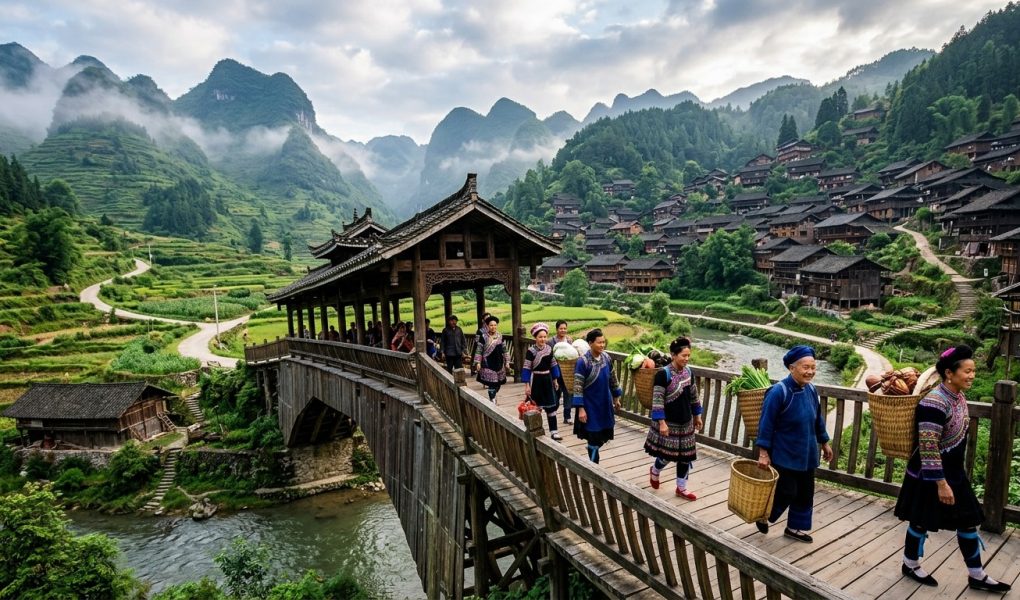
The train pulls into Kaili at dusk, and nobody meets you at the station. That is exactly the point. Guizhou Province sits in the middle of China like a secret someone left unattended. It is a mosaic of forested ridges, deep gorges, and wooden villages where the 21st century has arrived only partially and without much fanfare. You will not find a well-worn tourist trail here. You will find something better: the feeling that you arrived somewhere real.
Before You Go: Three Things Worth Knowing
- Guizhou is one of China’s least-visited provinces, and that is precisely what makes it worth the effort.
- Miao and Dong minority communities here maintain living traditions in textile, music, and rice farming that span centuries.
- Slow travel rewards you far more than any fixed itinerary could, and the best moments happen when you stop planning.
Sorting the Paperwork Before the Road Opens
Before any of this is possible, there is a step that deserves honest attention. China requires a visa for most nationalities, and the process is not something to leave until the week before departure. Getting it right is the first quiet act of commitment to this kind of travel. A thorough China visa guide will walk you through current requirements, document checklists, and application timelines without the guesswork. Do this early. Do it calmly. Then forget about it. The paperwork handled, the road opens up.
Why Guizhou Stays Off Most People’s Maps
China’s big-ticket destinations absorb almost all the attention. Xi’an has its terracotta warriors. Guilin has its karst peaks. Guizhou has neither a famous landmark nor a single postcard moment drawing charter flights. What it has instead is a concentration of minority ethnic cultures unlike anywhere else in the country. The Miao and Dong peoples have lived across these mountains for more than two thousand years, and their architecture, music, and craft traditions remain woven into daily life rather than preserved behind glass.
The province’s rugged topography is part of what protected that continuity. Roads into some villages were not paved until the 2010s. Certain hamlets are still reached only on foot. That geographic isolation, which kept outside influence at arm’s length for generations, now makes Guizhou one of the most quietly compelling places in all of East Asia for a traveler who moves at an unhurried pace.
Wooden Villages Built Without a Single Nail
The first thing you notice in a Miao or Dong village is the smell. Woodsmoke. Damp pine. Something faintly floral that you cannot quite place. The second thing is the architecture. The stilted wooden houses, called diaojiaolou, are constructed from timber without metal fasteners. They cling to steep hillsides, their lower floors open for livestock and storage, the living quarters lifted above the ground where mountain mist settles in the evenings. In Xijiang, which carries the reputation of the world’s largest Miao settlement, the effect at dusk is theatrical. From the ridge path, several hundred tiered homes flicker against dark forest like something from an old folk tale.
But Xijiang is known, and knowing changes places. Travel thirty minutes by road and things quiet down fast. The smaller villages along the Bala River valley receive a fraction of the visitors. In those places, children chase dogs down flagstone paths and grandmothers weave on open verandas, and nobody expects you or makes a performance of your presence. You are simply there, and that is enough.
The Deep Blue of Miao Indigo Cloth
Guizhou’s indigo textile tradition is one of the most distinctive craft cultures in China, and it is hiding in plain sight. The Miao women who practice it work with homegrown indigo plants, fermented into a dye bath that produces colors ranging from pale slate to a blue so dark it borders on black. After dyeing, the fabric is beaten with a wooden mallet to create a faint surface sheen. That process alone can take days for a single length of cloth.
In markets across the region, these textiles sit folded on wooden tables or hang from doorway beams. Some pieces are embroidered with geometric patterns that function as a kind of visual record, referencing myths, migrations, and family histories that predate written language in the community. Buying one of these pieces is not buying a souvenir. It is acquiring something with a story longer than the village road.
The craft is genuinely at risk. Younger generations are mobile, drawn to cities and the wages they offer. The women who still practice traditional dyeing and embroidery are often in their fifties and sixties. Sitting with one of them, watching her hands move through the fabric, is a reminder of how fast a tradition can dissolve when it stops being passed down.
Rice Terraces That Predate Modern Agriculture
In the southeast of the province, around Congjiang and Rongjiang counties, the landscape folds into something close to overwhelming. Rice terraces cut into hillsides at grades that look impossible from below, their surfaces catching light differently at each hour of the day. During planting season they fill with water and mirror the sky in flat silver sheets. At harvest, they turn amber and gold in slow waves as crews of farmers move from one terrace to the next.
These terraces were not designed by any agricultural authority. They evolved over centuries through communal labor and inherited knowledge, shaped by the specific contours of each hill. The Dong minority communities who farm them today use varieties of glutinous rice cultivated in the region for generations, and the farming calendar still follows festival dates and lunar cycles rather than market demands.
The Dong are also known for something that travels as well as the rice does. Their polyphonic folk singing, called Grand Song, carries a complexity and community function that earned it a place on UNESCO’s intangible heritage registry. Hearing it performed in a village gathering hall, with no amplification and no stage, is one of those experiences that resets your understanding of what music can do to a room full of people.
How to Move Through Guizhou Without Rushing It
The province has a growing rail network, and high-speed trains connect Guiyang, the capital, to several regional hubs. But the best travel here is local and slow. Minibuses run between towns on shifting schedules. Motorcycle taxis handle the last few kilometers to villages. Walking connects the rest.
A few things that help when thinking through a route:
- Kaili works well as a base for visiting the eastern Miao communities and traditional markets that rotate across the week between nearby villages.
- Zhaoxing is the most accessible of the larger Dong villages and rewards several nights rather than a single day trip.
- The Bala River area between Shiqiao and Yaorenbao is ideal for walkers willing to spend a full day on footpaths with no particular destination in mind.
- Guiyang has direct high-speed rail connections from major Chinese cities, making it a straightforward entry point for the province.
- Google Maps has limited reliability in rural valleys here. Baidu Maps and offline OpenStreetMap data serve better for navigation once you leave the paved roads behind.
Mandarin will carry you a long way, but Guizhou’s minority languages are distinct and very much alive. A few words of greeting in Miao or Dong, gathered from a phrasebook or a patient host, open more doors than any amount of confidence in standard Mandarin.
Village Markets Running on Their Own Time
One of the most underrated rhythms in rural Guizhou is the rotating market system. Each village hosts a market day on a different schedule, often following a five-day or ten-day cycle, and the circuit draws traders and buyers from the surrounding valleys. On market day, a quiet village transforms within hours. Stalls appear in the main square and along every connecting path. Vendors bring embroidered clothing, fresh produce, dried herbs, live chickens, and hand-forged tools.
The crowd includes teenagers in traditional dress walking alongside farmers in rubber boots, and older women comparing bolts of indigo fabric with the focus of any serious negotiation. Finding out when the market days fall requires asking locally or consulting a regional travel forum rather than any official tourism calendar. That small piece of information, gathered the night before from a guesthouse owner over tea, feels like something you earned rather than something a booking platform handed you.
And that distinction matters more here than in most places. Guizhou rewards the small effort. The village you find because a stranger pointed down a side path. The festival you stumble into because you chose to stay one more day. The morning meal that becomes a two-hour conversation with a family who has never hosted a foreign guest before. None of these appear in any itinerary because they cannot be scheduled. They require only patience and a willingness to follow where the road suggests rather than where the plan demands.
What Stays With You After the Road Ends
Guizhou does not reward impatience. It is not trying to. There are no landmark attractions competing for your attention and no infrastructure nudging you from one highlight to the next. What the province offers instead is an experience of place as something continuous rather than curated. A landscape and culture with their own internal logic, carrying on regardless of whether you have started to understand them yet.
The best days here tend to arrive without a plan. The morning you follow a path because it looked interesting and end up at a Dong carpenter’s workshop. The afternoon a family waves you in for rice wine and food you cannot name. The evening you sit on a guesthouse terrace while rain comes in over the mountains and the village below you disappears into fog and lantern light.
These are not moments any guide can guarantee. They are what happens when you trade efficiency for presence and let the road take its time. Guizhou has been carrying on for centuries without needing outside validation. The only real question is whether you are ready to slow down enough to see it.