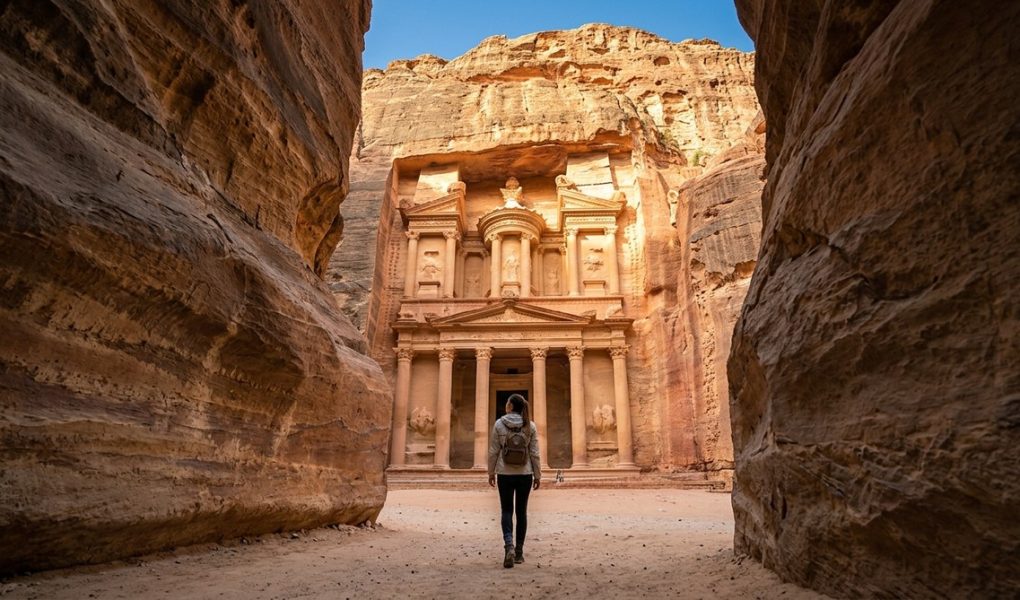
The Treasury emerges from the narrow Siq, its rose-red facade glowing in the morning light. For a moment, you are alone with one of the world’s great wonders. Then the tour buses arrive, and the silence shatters. But it does not have to be that way. With the right plan, you can experience Petra’s magic without the crush of selfie sticks and shouting guides. This guide is built around one mission: giving you the tools to avoid crowds Petra and carve out your own quiet version of the Lost City.
To escape the crowds at Petra, buy a two-day ticket, enter before 7:00 AM or after 4:00 PM, and hike to the Monastery or High Place of Sacrifice during midday crush. Avoid major holidays, visit in shoulder months (March, October), and stay at a guesthouse in Wadi Musa so you can walk to the gate. The extra day turns a rushed checklist into a peaceful discovery.
Why Petra Gets So Crowded (and Why You Can Still Win)
Petra is Jordan’s crown jewel. It draws over a million visitors each year, and most of them arrive between 9:00 AM and 2:00 PM. Cruise ships dock at Aqaba and disgorge hundreds of passengers. Tour buses from Amman and Jerusalem line up at the entrance. By 10:00 AM, the path between the Siq and the Treasury feels like a city sidewalk at rush hour.
But here is the secret: those crowds follow predictable patterns. They move together. They stop at the same photo spots. They leave by early afternoon. If you work outside their schedule, you will often have entire sections of Petra to yourself. The key is not to visit a less popular site; the key is to visit the same site at a different time.
The Best Times to Visit Petra in 2026
Timing is your strongest weapon. Aim for these windows:
Seasonally: The ideal months are March, April, October, and November. The weather is warm but not scorching, and crowds are moderate. Avoid Christmas, New Year, and Easter weeks. Also avoid the peak of summer (June to August) when heat and cruise-ship traffic hit maximum. If you can manage it, travel during Ramadan (which falls in late February to late March in 2026). During Ramadan, daytime crowds thin because locals are fasting, and many tour operators reduce their schedules. Restaurants and shops still operate for tourists, but the site itself becomes noticeably quieter.
Day of the week: Sundays through Wednesdays are lighter. Fridays can be busy with local families. Saturday is the heaviest day because of weekend tour packages.
Time of day: The golden windows are opening time (6:00 AM in summer, 7:00 AM in winter) and the last two hours before sunset. Most tours arrive between 9:00 AM and 11:00 AM and leave by 3:00 PM. If you enter at 6:00 AM, you can walk the entire Siq with no one in your photos. If you stay until closing, you can watch the sunset paint the Monastery in orange light with only a handful of other visitors.
| Factor | Morning (6:00 – 8:00 AM) | Afternoon (4:00 – 6:00 PM) |
|---|---|---|
| Crowd level | Very low near Treasury; moderate later | Low everywhere after 4:30 PM |
| Photography | Soft, golden light on the Treasury facade | Warm, angled light on the Monastery |
| Temperature | Cool and pleasant | Cooling down after the heat |
| Access to hiking trails | Trails are open, but shade is limited | Trails are open, better temps for climbs |
| Main drawback | Need to arrive before first light | Some structures may be in shadow |
Your Ticket Strategy: Buy a Two-Day (or Three-Day) Pass
The single biggest mistake travelers make is trying to see Petra in one day. It is physically possible, but you will spend half your time hustling between highlights and fighting for space at the Treasury. With a two-day ticket, you can split your visit into two focused sessions.
- Day One: Early Morning Treasury + Upper Trail. Enter at 6:00 AM. Walk straight to the Treasury while the Siq is empty. Snap your photos, then take the staircase trail up to the High Place of Sacrifice before the heat sets in. You will have the view almost to yourself. Descend, visit the Royal Tombs, and exit by noon.
- Day Two: The Monastery at Sunset. Sleep in, enjoy a lazy breakfast, then enter around 2:00 PM. Take your time walking through the Siq when it is busier, but you have already seen it empty. Reach the Monastery by 4:00 PM. The 800-step climb is easier in the afternoon shade. Stay for sunset. You will be one of the last people there.
A three-day ticket (common with the Jordan Pass) lets you also hike to Al-Beidha (Little Petra) on a half-day, or revisit a favorite spot without pressure.
Secret Routes and Alternative Entrances
Most visitors follow the main path: Visitor Center, Siq, Treasury, Street of Facades, Royal Tombs, and then maybe the Monastery. This creates a bottleneck. To avoid crowds Petra, you need to take the roads less traveled.
The Back Door to the Monastery: Instead of climbing the 800 steps from the main path, approach the Monastery from the top. You can do this by hiking the Wadi al-Jarra trail from the direction of Little Petra. It is a longer route (about 5 miles) but passes through remote ruins and ends at the Monastery from above, where few tourists go. You will need a guide for this route, but the solitude is worth it.
The High Place of Sacrifice via the Wadi Farasa Trail: Most people tackle the High Place via the obvious staircase behind the Treasury. Instead, take the Wadi Farasa trail that starts near the Theater. This route passes the Garden Tomb and a series of rock-cut houses, and you will meet almost no one until you reach the top. The view of the entire Petra basin from the High Place is even better when you are not sharing it with a tour group.
Little Petra as a Warm-Up: Little Petra (Siq al-Barid) is a smaller, less crowded version of the main site, about 6 miles north. It is included in the Jordan Pass and can be visited on the same day without extra cost. Go there first in the morning (around 8:00 AM) before the main site crowd builds. The painted ceiling in the biclinium is one of the best-preserved Nabataean frescoes in the region.
Where to Stay to Beat the Crowds
Your choice of accommodation in Wadi Musa directly affects how early you can enter Petra. If you stay in a hotel a short walk from the Visitor Center, you can be at the gate before the first shuttle buses arrive. If you stay in a place that requires a taxi, you risk adding 20 minutes of traffic.
- For early birds, consider Petra Moon Hotel or Movenpick Resort Petra. Both are within a five-minute walk of the entrance. The Movenpick is pricier, but you gain the ability to wake up at 5:45 AM and be inside the Siq by 6:00 AM.
- For budget travelers, Petra Palace Hotel and Valentina Inn offer affordable rooms with easy walking access. The trade-off is simpler facilities, but you are paying for location, not luxury.
- For a different experience, book a night at Little Petra Bedouin Camp. You will sleep in a traditional tent and wake up already at Little Petra. From there, you can hike the back trail to the Monastery, arriving before most people have finished breakfast.
“Most tourists stay in Amman and make Petra a day trip. They arrive at 9:30 AM and leave by 3:00 PM. If you stay in Wadi Musa for two nights, you effectively have three mornings and two evenings to explore. That is the real secret. No rush, no crowds, just Petra.” — Mohammad, a local guide from Petra Moon Tours
What to Pack for a Long, Crowd-Free Day
You will be on your feet for hours, climbing stairs, walking on uneven stone, and crossing sections without shade. Pack smart.
- Sturdy hiking shoes with good grip. The sandstone is slippery, especially near the Monastery steps.
- A reusable water bottle (at least 1.5 liters). Refill stations are available near the Visitor Center and the Basin Restaurant, but not on the trails.
- Sun protection: hat, sunglasses, high-SPF sunscreen. You will be exposed for long stretches.
- Snacks: trail mix, granola bars, dried fruit. Food inside the site is overpriced and limited.
- A light jacket or scarf. Mornings and evenings can be surprisingly cool, even in summer.
- A headlamp if you plan to stay until the last shuttle. The walk out can be dark.
- Cash in Jordanian dinars for small purchases. Not all souvenir stalls accept cards.
Common Mistakes That Ruin the Quiet Experience
Many visitors unknowingly sabotage their own peace. Here are the pitfalls to avoid:
- Believing one day is enough. You will spend half your time dodging crowds instead of absorbing the place.
- Entering between 9:00 AM and 10:00 AM. This is when the first wave of tour buses unloads.
- Skipping the climb to the Monastery. The view from the top is arguably better than the Treasury, and the crowds thin significantly after the first 400 steps because many people turn back.
- Visiting on a Saturday or during a public holiday. Check Jordan’s holiday calendar before booking (Prophet’s Birthday, Labor Day, Independence Day all attract domestic tourists).
- Not bringing water or snacks. Running out of energy turns a peaceful afternoon into a miserable march.
Final Advice for a Crowd-Free Petra Experience
Petra is not just the Treasury. It is a sprawling city of tombs, temples, hiking trails, and hidden canyons. The crowds concentrate in a handful of spots. Everywhere else is quieter. If you pace yourself, buy a multi-day ticket, and follow the timing strategies above, you will find yourself standing alone in front of a two-thousand-year-old facade, listening to the wind. That is the Petra most visitors never see.
Take your time. Let the tour groups rush past. You have nowhere else to be.