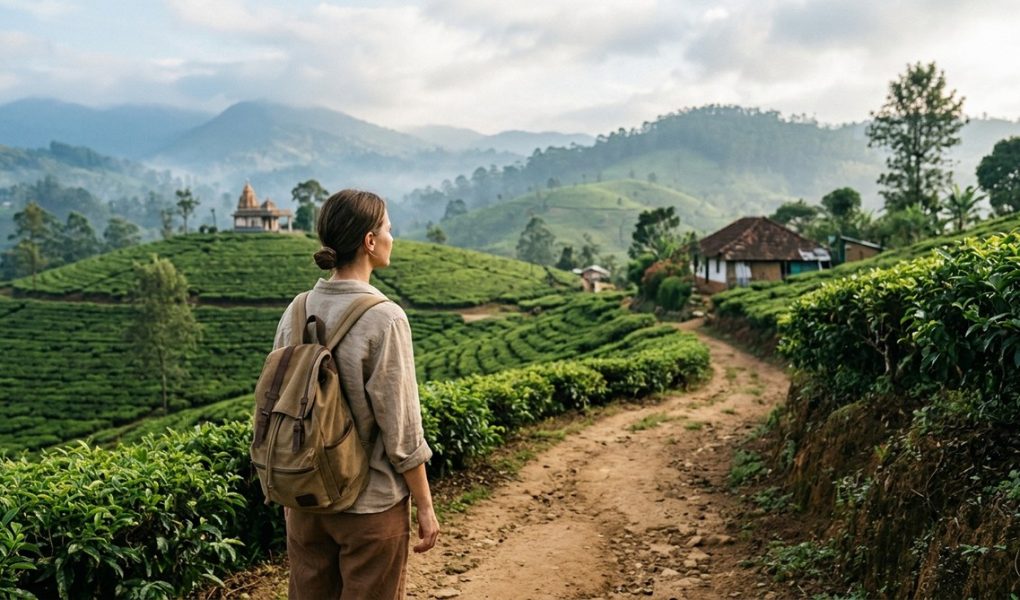
Picture this: you are sipping a cup of Ceylon tea on a quiet veranda in the hill country, watching mist roll over tea plantations while the only sound is birdsong and a distant train whistle. No tour buses. No selfie sticks. Just you and the rhythm of Sri Lankan life. That is the promise of slow travel. And in 2026, as more travelers seek meaningful experiences over checklist tourism, Sri Lanka remains one of the best places in the world to slow down, stay longer, and go deeper. Most two week itineraries try to cram in Colombo, Sigiriya, Kandy, Ella, Yala, Mirissa, Galle, and back to Colombo in a blur of five hour drives. You finish the trip exhausted, not restored. This 14 day slow travel itinerary Sri Lanka offers something different: a route that prioritizes depth over distance, connection over crowds, and sustainability over speed.
This 14 day slow travel itinerary Sri Lanka is built around three base locations that allow you to explore deeply without changing hotels every night. You will spend meaningful time in the Cultural Triangle, the hill country, and the southern coast, using each as a hub for day trips, local encounters, and spontaneous discoveries that most tourists miss entirely.
What Slow Travel Actually Means in Sri Lanka
Slow travel is not just about staying longer in one place. It is about changing your relationship with time itself. Instead of asking “what can I see next?” you start asking “what do I want to feel today?” In Sri Lanka, this shift opens doors that remain closed to rushed travelers.
When you spend three or four nights in a single area, something subtle happens. The shopkeeper at the corner store starts to recognize you. The guesthouse owner offers to show you where the elephants cross at dusk. A neighbor invites you to a family ceremony. These moments cannot be scheduled. They only appear when you stop racing.
This 14 day slow travel itinerary Sri Lanka uses three anchor towns: one near the ancient cities, one in the central highlands, and one along the quieter stretch of the southern coast. From each, you can make gentle day trips without packing your bags. You come back to the same pillow each night. You build familiarity. You travel light.
Why Most Two Week Sri Lanka Itineraries Leave You Drained
A standard 14 day Sri Lanka route often looks like a game of connect the dots. Day 1: arrive Colombo, drive to Negombo. Day 2: drive to Sigiriya, climb the rock, sleep. Day 3: drive to Kandy, see the tooth relic, sleep. Day 4: train to Ella, hike Little Adam’s Peak. Day 5: safari at Yala. Day 6: drive to Mirissa. Day 7: whale watching. Day 8: drive to Galle. Day 9: walk the fort. Day 10: drive back to Colombo.
That is ten locations in ten days. You spend roughly half your waking hours inside a vehicle. You pass through landscapes without feeling them. You meet locals only as service providers, not as people. And you contribute to the very overcrowding that makes places like Sigiriya and Mirissa feel less magical than they should.
The alternative is not about seeing less. It is about seeing better.
The Slow Travel Framework: Three Zones, Five Principles
This itinerary is built on five principles that guide every choice. Use this table to understand how the approach differs from the standard Sri Lanka route.
| Principle | Standard Approach | Slow Travel Approach |
|---|---|---|
| Base location | Change hotels every 1 to 2 nights | Stay 3 to 5 nights per base |
| Daily rhythm | Sightseeing from morning to night | Morning activity, afternoon rest, evening connection |
| Transportation | Private driver, long distances daily | Local trains, tuk tuks, short drives between bases |
| Accommodation | International hotel chains | Family run guesthouses and boutique eco lodges |
| Meal planning | Eat where tourists eat | Cook with local families, visit markets, eat seasonally |
Each principle works to reduce your carbon footprint, support local economies, and create space for spontaneous human connection.
Your 14 Day Slow Travel Itinerary Sri Lanka
Here is the route at a glance. Three bases. Two weeks. Zero wasted days.
Base 1: The Quiet Side of the Cultural Triangle (Days 1 through 5)
Most travelers base themselves in Sigiriya or Dambulla for two nights and rush through the main sights. You will base yourself in the village of Hiriwadunna, a short drive from Polonnaruwa but worlds away from the tourist infrastructure.
Day 1: Arrival and settling in
Fly into Colombo’s Bandaranaike International Airport. Instead of heading straight to a tourist hub, take a private car (about four hours) to Hiriwadunna. Check into a village homestay. Walk the dirt roads as the sun sets. Eat dinner with your hosts. Learn how to eat rice and curry with your right hand. Go to bed early. Jet lag will work in your favor tonight.
Day 2: Morning at Polonnaruwa, afternoon at the tank
Beat the crowds by arriving at Polonnaruwa as the gates open at 7:00 am. The ancient city is at its most atmospheric in the soft morning light. You will have the Gal Vihara Buddha statues almost to yourself. Spend three hours wandering the ruins. Return to your homestay by lunch. In the afternoon, walk to the nearby tank (reservoir) where local children swim and water buffalo cool off. Sit on the bank and read a book.
Day 3: Village life immersion
Spend the entire day on local experiences. Take a cooking class with a village family. Learn to make coconut sambol, dhal curry, and hoppers. In the afternoon, join a farmer for a walk through rice paddies. In the evening, visit a local temple for the puja ceremony. No entrance fees. No crowds. Just real life.
Day 4: Day trip to Sigiriya (arrive late, skip the queue)
Sigiriya is a madhouse by 9:00 am. The secret is to arrive at 2:00 pm. Most tour groups leave by lunch. The afternoon heat keeps casual visitors away. Climb the rock fortress in the golden late afternoon light. You will share the summit with maybe 20 people instead of 200. This is how Sigiriya was meant to be seen.
Day 5: Morning walk, afternoon transfer to the hill country
Take a final morning walk through the village. Say goodbye to your hosts. Then take the three hour drive to the hill country, settling into a guesthouse near the town of Haputale, which remains far less touristy than Ella.
Base 2: The High Country Without the Hype (Days 5 through 9)
Ella gets all the attention. Haputale gets the views, the tea, and the peace. You will base yourself here for four nights.
Day 6: Lipton’s Seat and a tea plantation walk
Wake early and drive to Lipton’s Seat. This viewpoint, where Sir Thomas Lipton once surveyed his tea empire, offers a panoramic view that rivals the more famous Ella Gap. You will likely share it with only a handful of other people. Afterward, walk down through the tea plantations. Stop at a small tea factory for a tasting. Talk to the pluckers. Learn why Ceylon tea tastes the way it does.
Day 7: The train from Haputale to Ella (without the crowd)
Everyone wants the Kandy to Ella train. It is crowded, noisy, and you fight for a window seat. Instead, take the local train from Haputale to Ella. It is the same stunning stretch of track through the hills. The difference is you start earlier, the carriages are emptier, and the experience feels authentic rather than performative. Spend a few hours in Ella if you like. Visit a waterfall away from the main trail. Return to Haputale by late afternoon.
Day 8: Dambatenne Tea Factory and a silent hike
Visit the Dambatenne Tea Factory, one of the oldest in Sri Lanka. The factory tour is humble and genuine. Then hike a section of the Pekoe Trail, a long distance walking route through tea country. This trail barely appears on tourist maps. You will walk through working plantations, past tiny villages, and alongside streams where women wash clothes and children wave.
Day 9: Transfer to the southern coast
Drive from the hills down to the southern coast. Your destination is the area around Tangalle, specifically the beaches between Tangalle and Dikwella. This stretch has fewer resorts and more character than Mirissa or Hikkaduwa.
Base 3: The Untamed Coast (Days 9 through 14)
The southern coast of Sri Lanka is famous, but most travelers cluster in a few spots. You will choose a quieter section.
Day 10: Recover by the water
Do nothing. Read a book. Swim in the ocean. Eat fresh fish from a beachside shack. Slow travel means honoring rest days. This is not wasted time. It is the whole point.
Day 11: Day trip to Galle Fort (on your own terms)
Galle Fort is beautiful but busy. Arrive around 3:00 pm when the day trippers are leaving. Walk the ramparts at sunset. Eat dinner at a small restaurant inside the fort walls. Return to your guesthouse after dark. You saw Galle without the stress.
Day 12: Learn from local fishermen
Visit a fishing village in the early morning. Watch the boats come in. Help sort the catch if they invite you. In the afternoon, learn how to cook the fish you saw earlier. This is the kind of experience that changes how you see a place.
Day 13: A quiet beach day and a farewell dinner
Spend your last full day on a beach that does not appear in any guidebook. Ask your guesthouse host to point you toward the nearest hidden cove. Walk there. Swim. Nap. In the evening, share a meal with your hosts. Thank them properly.
Day 14: Departure
Drive to Colombo airport (about three hours). Or extend your trip. Many people do.
Where to Stay for Quiet Immersion
Choosing the right accommodation makes or breaks a slow travel itinerary. Here are the types of places to prioritize.
- Village homestays in the Cultural Triangle: Look for places on Booking.com or through local agencies in Hiriwadunna. These are family homes with a spare room. You eat with the family. You learn about their lives.
- Eco lodges in the hill country: Around Haputale, you will find guesthouses run by former tea plantation workers. They offer simple rooms, incredible views, and home cooked meals. The lack of luxury is the luxury.
- Beach guesthouses near Tangalle: Avoid the large resorts. Look for small guesthouses run by families. Many have gardens that run right down to the sand. Ask about beachfront rooms with a hammock.
- Boutique hotels for a splurge: If you want one or two nights at a higher end property, book something like the Jetwing properties in the Cultural Triangle or a small boutique villa near Galle. Use these as accents, not the main structure of your trip.
How to Move Between Slow Zones
Transportation is where most itineraries fall apart. Here is a step by step process for getting around without burning out.
-
Arrange a private driver for the three long transfers. Airport to Hiriwadunna. Hiriwadunna to Haputale. Haputale to Tangalle. This costs about $80 to $100 per transfer and saves you five hours of bus connections. Ask your homestay to recommend a driver they trust.
-
Use tuk tuks for day trips. Negotiate a half day rate with a local tuk tuk driver. They know the roads, the shortcuts, and the best places to eat. A half day should cost $15 to $25.
-
Take the train for the hill country segment. The Haputale to Ella train is cheap, scenic, and memorable. Book second class or third class for the most authentic experience. First class has air conditioning but sealed windows, which defeats the purpose.
-
Walk whenever possible. This itinerary is designed so that many of your destinations are within walking distance of your base. The village paths, the tea plantation trails, the coastal walks. These are the real Sri Lanka.
“The best advice I can give anyone visiting Sri Lanka is to stay in one place for at least three nights. The first night you are still traveling. The second night you relax. But the third night, that is when the magic happens. That is when a neighbor knocks on your door with fresh king coconut. That is when the family invites you to a wedding. You cannot buy those moments. You can only earn them by staying still.” (Sumedha Jayasuriya, homestay host in Hiriwadunna)
Common Mistakes Even Experienced Travelers Make
| Mistake | Why It Hurts Your Trip | The Slow Fix |
|---|---|---|
| Booking everything in advance | You lock yourself into a schedule with no room for spontaneity | Book your first three nights, then decide in country |
| Visiting Sigiriya in the morning | You join the worst crowds of the day | Go at 2:00 pm when buses leave |
| Taking the Kandy to Ella train | You compete with hundreds of tourists for photos | Start from Haputale instead |
| Staying in Mirissa or Hikkaduwa | You pay resort prices for crowded beaches | Choose Tangalle or Dikwella area |
| Eating only at tourist restaurants | You miss the best food in the country | Eat where local families eat, even if the menu is handwritten |
How This Itinerary Supports Local Communities
Every choice in this 14 day slow travel itinerary Sri Lanka directs money toward people who need it most. Village homestays keep tourism dollars in rural families. Small guesthouses employ local staff. Cooking classes and village walks provide income for artisans and farmers. When you buy a meal from a roadside vendor or hire a local guide for a day hike, you are participating in a form of travel that builds economic resilience.
This is not a guilt trip. It is simply a better way to travel. The food tastes better. The connections feel more real. And you leave knowing your presence made a positive difference.
This approach also aligns with the broader philosophy of traveling with intention. Whether you are learning about how traditional craftsmanship reveals a destination’s soul or discovering where locals actually eat in tourist heavy cities, the same principle applies: go slow, stay local, and let the place reveal itself.
Why This Route Works Better in 2026
Sri Lanka has changed since the pandemic. Tourism rebounded, but not evenly. The famous spots are more crowded than ever. The quiet spots are still quiet. Airlines added new routes to Colombo in 2025 and 2026, making the country more accessible than a decade ago. But the infrastructure in rural areas remains gentle and unhurried.
That window of relative peace in places like Haputale and the Tangalle coastline will not stay open forever. As more travelers discover the value of slow travel, these hidden corners will gradually appear on more itineraries. For now, they remain the secret that experienced travelers keep to themselves.
If you want to combine this trip with another region, consider how island hopping through Greece offers a similar slow travel philosophy or how planning a temple trail in Southeast Asia without crowds uses the same principles. The mindset transfers across continents.
Making This Itinerary Your Own
This route is a starting point, not a rulebook. If you love hiking, add an extra night in the hill country and tackle longer sections of the Pekoe Trail. If you are a beach person, skip a day in the Cultural Triangle and add it to the coast. If you meet someone who invites you to a village festival, change your plans. That is the whole spirit of slow travel.
The best trips are not the ones where you check off every sight. They are the ones where you come home changed. Where you remember the taste of a mango eaten under a tree. Where you still hear the sound of temple bells in the quiet moments of your daily life.