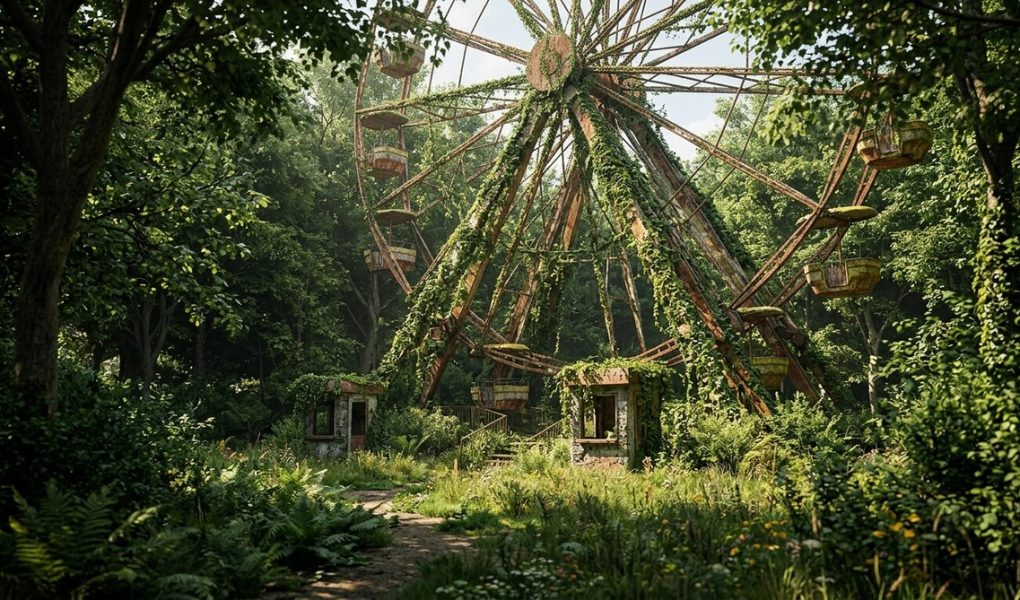
There is a strange beauty in watching a roller coaster disappear under a blanket of kudzu. When a theme park closes, the silence arrives, and then the greenery moves in. Broken Ferris wheels become bird perches. Ticket booths turn into terrariums. For curious explorers, urban decay enthusiasts, photographers, and history buffs, these forgotten sites offer a rare glimpse of nature’s reclamation. They are not just ruins. They are living museums where steel and concrete slowly return to the earth. If you have ever stood before a rusted turnstile wrapped in wild ivy, you know the feeling. Time stops. The world rewinds. And in that quiet, you witness something powerful: the planet quietly reclaiming what was once taken.
Abandoned amusement parks reclaimed by nature offer hauntingly beautiful landscapes for travelers who seek something beyond typical tourist spots. From Japan to Louisiana, these forgotten places tell stories of economic failure, natural disaster, and cultural change. This guide covers the most photogenic parks, how to visit them safely and ethically, and what gear you need to capture their eerie charm.
The Haunting Appeal of Nature’s Takeover
What draws people to a place where laughter has been replaced by wind rustling through rusted chains? Part of it is curiosity. You wonder what happened to the families who once waited in line for the Tilt-A-Whirl. Part of it is visual. A carousel half sunk into mud, its painted horses faded and chipped, looks like a still from a dream. And part of it is the quiet thrill of standing somewhere that was once full of noise and now holds only silence. Nature does not judge. It just grows. Vines climb the supports of a log flume. Moss carpets the pavement. Trees sprout through the floor of a bumper car arena. This slow takeover creates scenes that no architect could have planned.
Where to Find These Forgotten Playgrounds
You do not need to travel to a remote jungle to find an abandoned amusement park reclaimed by nature. Some are surprisingly close to major cities. Others require a bit more effort. Here are a few standout spots worth your time.
-
Six Flags New Orleans (Louisiana, USA). After Hurricane Katrina, the park flooded and never reopened. Today, the parking lot is cracked with weeds, and the Zamperla rides are stained with rust. It is one of the most photographed abandoned parks in America. Because it sits on protected wetlands, nature has moved in fast. Herons nest in the roller coaster structures.
-
Nara Dreamland (Nara, Japan). Modeled after Disneyland, this park closed in 2006. For years it remained frozen in time, with fading murals and empty teacup rides. Demolition began in 2016, but you can still see traces of its former life in the surrounding forest. The Japanese pagoda style buildings crumble beautifully against the green hills.
-
Spreepark (Berlin, Germany). Located along the Spree River, this park operated for decades before bankruptcy. The giant spinning dinosaur is now covered in graffiti and moss. Guided tours are available, but even from the outside you can see how the trees have swallowed the tracks of the roller coaster.
-
Pripyat Amusement Park (Pripyat, Ukraine). This park never officially opened. The Chernobyl disaster happened just days before its planned inauguration. The Ferris wheel, painted in Soviet red and white, now stands among a forest that grew up around it. Radiation levels have dropped, but you can only visit with an official guide.
-
Joyland (Wichita, Kansas, USA). This classic American park closed in 2004. The wooden coaster, the Wildcat, still towers over the property, but the track is now lined with wild grapevines. It is privately owned, so you need permission to enter, but the view from the road is worth the detour.
-
Fun Time Fyn (Funen, Denmark). A Danish park that closed in 1991. The rides were sold off, but the forest took over the empty pathways. What remains feels like a fairy tale abandoned by its characters. Birch trees grow through the ticket booths.
How to Plan Your Visit to an Abandoned Park
Visiting these sites is not the same as booking a weekend at Disney World. You need preparation, respect, and a good dose of caution. Follow these steps to make your trip both safe and rewarding.
-
Research access laws. Some parks are on private property. Trespassing can lead to fines or worse. Check local regulations, look for official tour operators, or contact local historical societies. For example, Spreepark runs guided tours that keep you on legal paths. Do not assume because a gate is open you are welcome.
-
Check safety conditions. Abandoned structures can collapse. Rotten wood, loose concrete, and exposed rebar are real hazards. Bring a hard hat or at least a bump cap. Watch where you step. Never climb on roller coaster supports or old ride platforms.
-
Pack the right gear. A flashlight with extra batteries is essential. Wear sturdy boots with good grip. Bring water and snacks because you might be walking for hours with no services nearby. A first aid kit is smart, especially for cuts from rusty metal.
-
Go during daylight hours. Many parks are dangerous at night due to uneven ground, wildlife, and the risk of encountering people who may not want visitors. Sunrise and sunset provide the best light for photography anyway.
-
Leave no trace. Take nothing but photographs. Do not remove pieces of metal, tiles, or signage. Do not spray paint or add graffiti. Respect the space as a historical artifact. The goal is to observe, not to change.
What to Bring: A Practical Gear Table
The right equipment makes a huge difference when wandering through a place that has been reclaimed by vegetation. Below is a table showing common items, why you need them, and the mistakes people often make.
| Item | Purpose | Mistake to Avoid |
|---|---|---|
| Sturdy hiking boots | Protect feet from broken glass, nails, and uneven debris | Wearing sneakers or sandals, which offer no ankle support |
| Long pants and long sleeves | Shield skin from poison ivy, thorns, and insect bites | Wearing shorts, even in summer. The vegetation is aggressive |
| Flashlight or headlamp | Light up dark indoor areas like maintenance tunnels and old arcades | Forgetting backup batteries. Many interior rooms have zero natural light |
| Reusable water bottle | Stay hydrated during long walks under the sun | Carrying only a small bottle. You may be out for hours with no water source |
| Camera with a zoom lens | Capture details without stepping into unsafe zones | Getting too close to unstable structures for that perfect shot |
| Printed map or offline GPS | Navigate without cell service, which is often absent in these areas | Relying only on a phone that can die or lose signal |
The Ethics of Urban Exploration
Walking through abandoned spaces is a privilege, not a right. You are stepping into a place that holds memories, even if those memories are rusty and faded. The urban exploration community has an unwritten code: do not vandalize, do not steal, and do not share exact locations if that could lead to damage. Some photographers argue that keeping coordinates secret helps preserve the sites.
“The best way to honor an abandoned park is to document its decay without interfering with it. Let the vines climb. Let the paint peel. Your job is to witness, not to rescue.” Maya Chen, documentary photographer and urban explorer
Keep that in mind as you plan your trip. If you see others leaving trash or carving names, gently remind them that these places belong to history. And if you are unsure whether a site allows visitors, assume it does not. Better to admire from a distance than to cause harm.
Signs That Nature Is Winning
When you arrive at an abandoned amusement park reclaimed by nature, you will notice certain patterns. The vegetation does not just cover things. It remakes them. Here are a few signals that nature has fully taken the lead.
- Vines completely encase entire ride cars. The metal becomes a skeleton for green growth.
- Trees growing through concrete. Roots split pathways and foundation slabs.
- Animal nests inside ticket booths. Birds, raccoons, and even foxes find shelter.
- Pools of water on ride platforms. Rain collects and becomes mini ponds, home to frogs and dragonflies.
- Fading paint turned into a canvas for moss. The bright primary colors of carousels soften into muted earth tones.
- The smell of wet wood and damp metal. The air carries a permanent scent of decay and renewal.
Each of these details tells a story of time passing. A coaster that once launched into a loop now sways slowly in the wind, held together by rust and roots. It is both sad and beautiful.
A Final Word on Preserving the Mystery
Abandoned amusement parks reclaimed by nature are not just attractions. They are time capsules that remind us of impermanence. The best way to experience them is with patience and humility. Bring your camera, but also bring your curiosity. Ask yourself what stories these silent Ferris wheels could tell if they could speak. And when you leave, carry only the memory of vines curling through a broken loop.
If these forgotten places stir something in you, you might also enjoy finding other overlooked historical sites. The process of discovering them before they gain widespread attention is part of the adventure. Learn how to find these hidden corners of the world by reading our guide on And for more inspiration on where to travel next, check out https://touriosity.travel/15-underrated-european-cities-that-rival-paris-and-rome/ or our list of Each destination offers a different kind of quiet beauty. Some are alive with nature. Others are waiting for you to notice them.
Go with respect. Go with wonder. And let the reclamation begin.