The first time I landed in Tokyo, I stuck out my hand for a handshake before my brain caught up with where I was. The Japanese businessman I was meeting looked at my outstretched palm with polite confusion, then gave a small bow. I felt my face go red. That moment taught me something no guidebook had stressed enough: a greeting is not just a hello. It is a key. Use the wrong one, and the door stays shut. Use the right one, and people lean in. They trust you faster. They share better recommendations. They invite you to dinner. In years of travel since, I have learned that local greeting customs are the single most underrated tool for building genuine connections abroad. This guide covers seven essential greetings that will open doors for you in 2026 and beyond.
Local greeting customs are not optional etiquette rules. They are social shortcuts that signal respect, build trust, and create instant rapport. This guide covers seven essential greetings from Japan, Thailand, France, New Zealand, India, the Middle East, and Kenya. You will learn the correct technique, common mistakes, and how to adapt in real time.
Why Your Greeting Matters More Than Your Words
Think about the last time someone greeted you in a way that felt wrong. Maybe they stood too close. Maybe they used your first name when you expected a title. That feeling of unease is instant. It colors everything that follows.
Travelers often focus on learning “please” and “thank you” in a local language. That is good. But the physical act of greeting happens before you say anything. It sets the emotional temperature of the entire interaction. A respectful greeting tells the other person: I see you. I honor your customs. I am safe to engage with.
A bad greeting does the opposite. It says: I am in a hurry. I assume my way is the universal way. I have not bothered to learn about you.
Local greeting customs are not about perfection. They are about effort. People almost always forgive a clumsy attempt if they see you are trying. What they do not forgive is a lack of awareness.
1. The Japanese Bow: Depth Communicates Respect
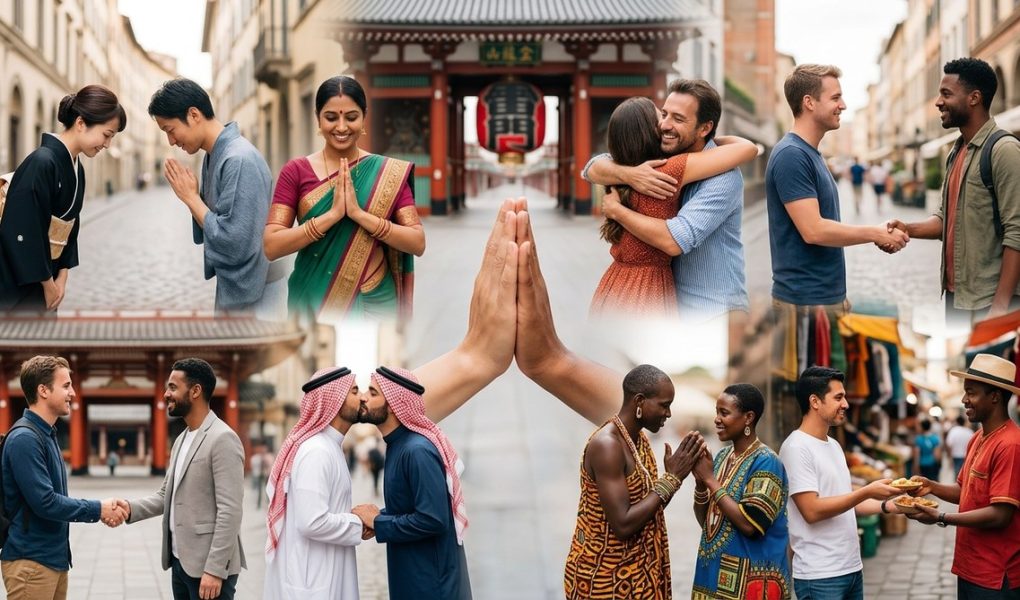
Japan is perhaps the most codified greeting culture in the world. The bow (ojigi) is not a single movement. It has layers.
A shallow bow of about 15 degrees is for casual encounters with peers. A bow of 30 degrees shows respect to a superior or a client. A deep bow of 45 degrees is reserved for formal apologies or deep gratitude. The rule of thumb: the longer you hold the bow, the more respect you show.
Keep your hands at your sides if you are a man, or clasped in front if you are a woman. Make eye contact before and after the bow, but not during. Looking directly at someone while bowing is considered aggressive.
A handshake is becoming more common in business settings, but let the Japanese person initiate it. If they offer a handshake, use a light grip. A firm American-style squeeze can feel intimidating.
“In Japan, the bow is a mirror of the relationship. It shows where you stand. A rushed bow is worse than no bow at all.” — Hiroko Matsumoto, cross-cultural communication trainer
2. The Thai Wai: Hands Together, Head Lowered
The wai is the traditional Thai greeting. You press your palms together at chest level, fingers pointing upward, and bow your head slightly. It looks similar to a prayer gesture.
The higher you hold your hands, the more respect you show. For a peer, keep your hands at chest level. For a monk or a very senior person, raise your hands to your forehead. For a child or someone younger, keep your hands lower.
Never point your feet at someone while performing the wai. Feet are considered the lowest and dirtiest part of the body. Also avoid touching someone’s head, even playfully. The head is sacred in Thai culture.
In casual settings, Thais often just say “Sawasdee” with a nod. But if someone offers you a wai, return it. Not returning a wai is like ignoring an outstretched hand.
3. The French Bise: Air Kissing Has Rules
The bise (cheek kissing) is the standard greeting in France, but it is not as simple as it looks. The number of kisses varies by region. In Paris, most people do two. In the south, you might do three. In some parts of Brittany, it is four.
The key is to follow the lead of the person you are greeting. Lean in, make a light kissing sound in the air, and touch cheeks. Actual lip contact is not required. Always start with your right cheek.
Do not attempt the bise in a formal business meeting. A handshake is the standard for professional first encounters. The bise is reserved for friends, family, and social settings.
A common mistake is trying to shake hands while doing the bise. Choose one or the other. Also, men do the bise with men in France. It is not unusual. It is normal.
4. The Maori Hongi: Pressing Noses in New Zealand
The hongi is a traditional Maori greeting in New Zealand. You press your nose and forehead against the other person’s nose and forehead. You share the breath of life (ha). It is intimate. It is powerful.
This greeting is not used in every situation. It is most common in formal Maori ceremonies, on marae (meeting grounds), or when someone welcomes you with a hongi. If a Maori elder offers you a hongi, accept it with humility. Do not pull away. Do not laugh.
For everyday interactions in New Zealand, a simple handshake or a nod works fine. But if you are visiting a marae or attending a cultural event, learn the hongi. It shows deep respect for Maori culture.
A related custom: remove your shoes before entering a Maori meeting house (wharenui). And do not sit on tables or pillows. They are considered tapu (sacred).
5. The Indian Namaste: No Touch Required
The namaste (or namaskar) is a versatile greeting used across India, Nepal, and much of South Asia. You press your palms together at chest level and bow your head slightly. It means “I bow to the divine in you.”
This greeting is perfect for travelers because it avoids the complexities of handshake etiquette. In India, the left hand is considered unclean. A handshake with the left hand is offensive. But with namaste, there is no hand contact at all. It is safe. It is respectful.
Use namaste for everyone: elders, shopkeepers, taxi drivers, business partners. It works in formal and casual settings.
If someone extends their hand for a handshake, accept it, but use your right hand. Also, avoid touching someone of the opposite gender unless you are certain they are comfortable with it. In conservative areas, namaste is the better choice.
6. The Middle Eastern Handshake: Right Hand Only
Across the Arab world, the handshake is the standard greeting, but it comes with rules.
Always use your right hand. The left hand is reserved for hygiene. A left-handed handshake is deeply insulting. If your right hand is occupied or injured, apologize and explain rather than offer your left.
Hold the handshake longer than you would in the United States. A brief pump can feel rushed. Keep eye contact throughout. Releasing too early can signal disinterest.
After the handshake, men often touch their chest over their heart as a sign of sincerity. You can mirror this gesture. It is a small move that carries weight.
When greeting an elder or a person of high status, stand up if you were seated. Do not lean on a wall or slouch. Posture matters.
If you are greeting a woman in a conservative setting, wait for her to offer her hand first. Many Muslim women prefer not to touch men outside their family. A nod and a verbal greeting are perfectly acceptable.
7. The Kenyan Handshake: A Conversation in a Grip
In Kenya and much of East Africa, the handshake is not a single motion. It is a process.
The standard Kenyan handshake starts with a normal grip, then the hands slide together so you are gripping each other’s thumbs, then they slide back to a full palm grip. It takes about three seconds. It feels like a small dance.
You maintain eye contact throughout. You ask “How are you?” (often “Orit?” in Sheng slang) and wait for a real answer before moving on. The greeting is not a formality. It is a genuine moment of connection.
Use your right hand. If your right hand is dirty or carrying something, offer your left wrist instead. Touching the forearm or shoulder with your left hand while shaking with your right is a sign of warmth.
Do not rush this greeting. Kenyans often spend several minutes on greetings before discussing business. Skipping this step is seen as rude and transactional.
A Practical Process for Learning Any Local Greeting
You cannot memorize every greeting on earth. But you can build a system for learning them before each trip.
-
Research the greeting hierarchy. Is the greeting different for elders? For monks? For business partners? Write down the three most common scenarios you will face.
-
Watch video examples. Reading about a bow is not the same as seeing the angle. Search for “Japanese bow tutorial” or “Thai wai demonstration” on YouTube. Watch three examples.
-
Practice the physical movement. Stand in front of a mirror. Do the gesture five times. Notice how it feels in your body. Awkwardness fades with repetition.
-
Learn one local phrase to pair with the gesture. In Japan, say “Hajimemashite” (nice to meet you) with your bow. In France, say “Bonjour” before the bise. The combination signals effort.
-
Watch locals on arrival. Your first hour in a new country is research. Observe how people greet each other at the airport, at a cafe, in a hotel lobby. Mirror what you see.
-
Ask a local for feedback. Say, “I want to greet people correctly here. Am I doing this right?” People love teaching their customs to someone who cares.
-
Apologize if you get it wrong. A sincere “I am sorry. I am still learning. Please show me the correct way” fixes almost any mistake.
Greeting Mistakes to Avoid: A Reference Table
| Mistake | Why It Hurts | Better Approach |
|---|---|---|
| Using left hand in India or the Middle East | Considered unclean and disrespectful | Always use right hand; offer namaste if unsure |
| Firm handshake in Japan | Reads as aggressive or dominant | Use a light grip; let the Japanese person set pressure |
| Rushing the greeting in East Africa | Feels transactional and cold | Spend 30 seconds on greetings before talking business |
| Touching someone’s head in Thailand | The head is sacred | Keep hands below shoulder level |
| Kissing the wrong cheek in France | Breaks the rhythm of the bise | Follow the other person’s lead; start right cheek |
| Bowing too shallow in Japan | Signals low respect | Bow deeper for elders and superiors |
| Skipping the greeting entirely | Communicates that the person does not matter | Always greet before stating your business |
How to Adapt When You Are Unsure
Even with preparation, you will face situations where you do not know the right greeting. This happens to everyone. The key is to have a fallback.
A smile, a nod, and a gentle “Hello” in the local language work in almost every culture. Pair it with an open palm over your heart. That gesture is understood across continents as sincerity.
If someone offers a greeting you do not recognize, mirror them. Do not freeze. Do not apologize excessively. Just follow their lead. Most people will appreciate the attempt more than they judge the execution.
For business travelers, a good rule is to start formal. Use titles and last names. Wait for the other person to suggest moving to first names. In many cultures, including Japan and South Korea, using a first name too early is presumptuous.
For solo travelers and backpackers, the stakes are lower but the rewards are higher. A correct greeting at a homestay or a local market can turn a transaction into a friendship. If you are planning a trip that involves deep cultural immersion, reading up on what can a local homestay teach you that no hotel can will help you prepare for those intimate greeting moments.
The Deeper Lesson Behind Every Greeting
Local greeting customs are not just about avoiding embarrassment. They are about signaling that you value the relationship over the transaction. They show that you are willing to step out of your own cultural comfort zone to meet someone in theirs.
That willingness is rare. It is memorable. It is the reason a shopkeeper in Marrakech invites you for tea, or a taxi driver in Nairobi gives you his personal number for your next visit, or a host in Kyoto writes down her favorite restaurant on a napkin.
These are the moments that transform a trip into a meaningful experience. They start with a single gesture.
So the next time you travel, do not just pack your passport and your power adapter. Pack a greeting. Learn the bow. Practice the wai. Master the three-part handshake. It takes five minutes of preparation and pays back in connections that last a lifetime.
Your Greeting Is Your Introduction to the World
Every person you meet abroad is a potential teacher. Every greeting is a chance to learn something about how they see the world. The Japanese bow teaches humility. The Thai wai teaches reverence. The Kenyan handshake teaches patience.
When you approach local greeting customs with curiosity instead of anxiety, the whole dynamic shifts. You stop worrying about getting it wrong and start enjoying the process of getting it right. You become the traveler people remember. The one who tried. The one who cared.
That is the kind of traveler who gets invited to family dinners, shown hidden trails, and trusted with local secrets. That is the kind of traveler who does not just visit a place. They connect with it.
Start with the greeting. The rest will follow.