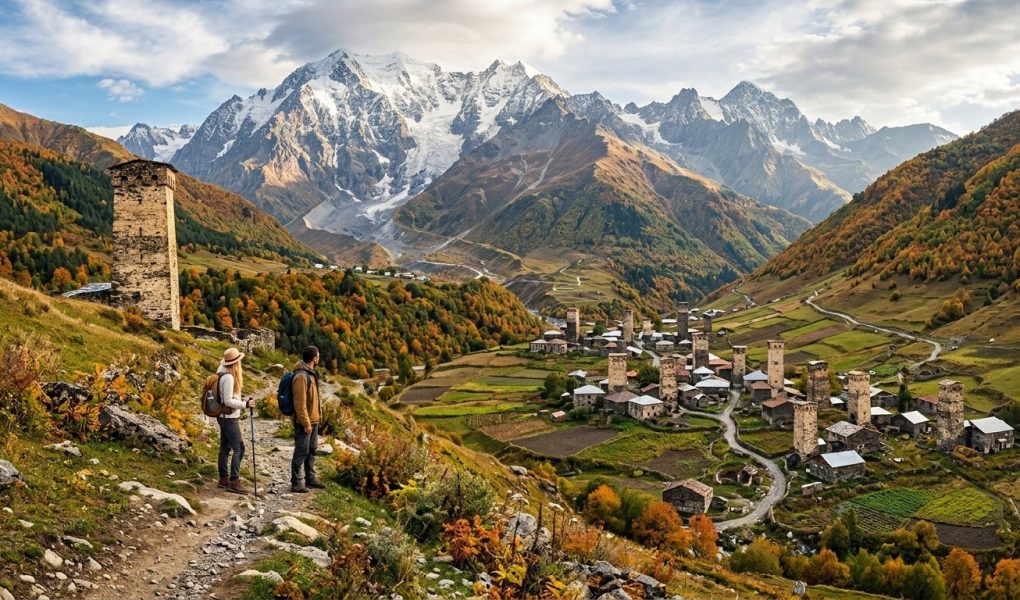
The marshrutka from Zugdidi takes five hours on a good day. You spend most of it gripping the seat back while the minivan crawls up switchbacks above the Enguri River gorge, the road narrowing to barely a single lane at points where the cliff drops away into nothing. By the time Mestia’s medieval towers appear through the dusty windshield, you feel like you have arrived somewhere genuinely outside the rest of the world. Most travelers spend two nights, rush out to Ushguli, take the photograph, and leave on the next van south. I stayed for two weeks. What opened up in that extra time changed the way I think about travel entirely.
Two Weeks in Svaneti: Key Takeaways
- The standard three-day Svaneti loop shows you the towers but skips the culture that built them
- Staying in a family guesthouse for a week or more earns access to Svan life that no tour can arrange
- Trail connections between villages like Latali, Lenjeri, and Ushguli are best walked without a fixed schedule
- Connectivity in the upper villages is genuinely unreliable, so sorting data before you arrive matters
- Upper Svaneti holds one of Europe’s highest concentrations of intact medieval defensive towers, earned over centuries of isolation
The Three-Day Circuit and What It Leaves Behind
The standard Svaneti itinerary is well-worn for a reason. Arrive in Mestia, hike to Koruldi Lakes on day two, take a shared jeep to Ushguli on day three, and catch the early marshrutka back on day four. It is a decent itinerary. You will see towers. You will see mountains. You will eat khachapuri by a fire and feel genuinely glad you came.
But Svaneti does not reveal itself in three days. The region is not a highlight reel. It is a living mountain culture that has been largely cut off from the outside world for centuries, and the communities here operate on their own clock, their own rhythms, their own logic. Three days gives you the surface. Two weeks gives you something that takes longer to name.
The towers themselves tell part of the story. Upper Svaneti holds an extraordinary concentration of intact medieval defensive structures, and in 1996 the area received its World Heritage designation, recognizing both the towers and the traditional Svan villages surrounding them. Standing in Chazhashi, the tower cluster at the edge of Ushguli, knowing these structures date back to the ninth through thirteenth centuries, you understand why a two-night stay cannot carry much weight. The place earns more the longer you stand in it.
The travelers who rush through are not doing anything wrong. Time is finite. But they are leaving the most compelling parts untouched, and most of them never know it.
Settling Into the Guesthouse Rhythm
Most visitors book a guesthouse for two nights and treat it like a hotel. But family guesthouses in Mestia, and the smaller villages beyond it, operate differently. The family is always present. Meals are shared at the same table. The daughter of the house may sit with you in the evening and ask where you come from. The grandfather may pour you a glass of local chacha without being asked, which is less a hospitality gesture and more a statement of fact.
By my fifth day at a guesthouse on the edge of Mestia, I had stopped eating dinner alone. I was passed the communal pot before I thought to ask for it. The pace changed. Conversation got slower and more specific. I started to understand what the family was proud of, what they worried about, what they thought of the tourists who arrived and left inside a long weekend.
That kind of access is not something you can schedule. It accumulates. It requires staying past the point where you are still a novelty and becoming, briefly, a fixture in someone else’s routine.
Getting Ready Before You Lose Signal
Svaneti’s remoteness is genuine, not curated for atmosphere. Mobile coverage in the upper villages is patchy at best, and the one phone shop in Mestia that sometimes stocks local SIM cards often runs out, carries outdated stock, or operates on hours that bear no relationship to any posted sign. Before leaving for the Caucasus, I sorted this out at home. Picking up a free travel eSIM before departure meant arriving with data already active, not hunting through a half-stocked shop while the marshrutka driver waited outside. It is the kind of quiet, unremarkable decision that experienced independent travelers make to stay fully present once they get somewhere worth being present in.
Offline maps matter here too. I downloaded the entire Svaneti region in both Maps.me and OsmAnd before leaving Tbilisi. That paid off on more than one afternoon when I was mid-trail between villages with no signal and needed to confirm a junction.
Walking Between Tower Villages Without a Fixed Plan
The hiking in Svaneti is extraordinary, and most of it is completely free of organized tourism. The trails connecting villages like Latali, Lenjeri, Becho, and the upper hamlets around Ushguli are old mule paths, stone-stepped in places, with no entrance fee and no official trailhead signage. They work on trust and logic. You follow the ridge, cross the river at the obvious ford, and the next village appears when it appears.
With two weeks available, I could walk for four hours and then stop for a full rest day when my legs asked for it. I could linger in Lenjeri for an extra night because the weather had turned dramatic and the clouds were doing something worth watching. I could abandon a planned route entirely and take the lower forest path because a man on horseback told me the upper trail was wet and that I should go his way instead.
None of that flexibility exists on a three-day itinerary. You are always watching the clock. You are always calculating whether you can still reach Ushguli if you stop here for lunch. That constant arithmetic is exactly what a place like Svaneti does not deserve.
The Route Most Day-Trippers Never Take
The trail north from Mestia toward Zhabeshi and down into the Chalaadi Glacier valley is genuinely underused. Walked properly, with time spent at the glacier’s terminal moraine and the river crossing below it, it fills a full day. Tour groups rarely attempt it because the return leg is uphill and the timing is too tight for a half-day excursion. With no schedule, I walked it on a quiet Tuesday, saw four other people all day, and ate lunch on a boulder above a milky glacial stream in something close to complete silence.
What Earning a Seat at the Svan Table Actually Means
Georgian food culture operates on generosity as a default setting. Meals are long, toasts are frequent, and refusing a refill requires more effort than accepting one. In Svaneti specifically, the food carries its own regional identity. Kubdari, the Svan meat-filled bread, is thicker and spicier than the khachapuri you find in Tbilisi. Svan salt, a blend of ground spices and dried herbs particular to the region, turns up on every table and in every pot.
By the end of my first week, I was eating dinner with the guesthouse family most nights. By the end of the second, I had been invited to a neighbor’s house for a meal that involved four courses, a long argument about local politics I could not follow, and a toast to Georgia, to guests, to the mountains, and to the specific cow that had provided the evening’s cheese. I have no idea what order that all happened in. The evening was not designed for my comprehension. I was simply included in it.
That inclusion is the thing the three-day visitor misses entirely. Not through any fault of their own. Simply through not having stayed long enough to stop being a tourist.
What Three Days Versus Two Weeks Actually Gets You in Svaneti
| Category | Three-Day Loop | Two-Week Stay |
|---|---|---|
| Villages reached | Mestia, Ushguli by jeep | Mestia, Ushguli, Latali, Lenjeri, Zhabeshi, smaller hamlets on foot |
| Trail access | Koruldi Lakes main route | Inter-village paths, glacier trails, ridge walks, forest routes |
| Local connection | Polite guesthouse exchange | Shared meals, evening conversations, neighbor invitations |
| Daily flexibility | Every hour is scheduled around departure | Weather, invitations, and energy dictate the day |
| Typical daily cost | Higher, due to jeep hire and rushed logistics | Lower, with guesthouse half-board and self-guided walking |
The Kind of Place That Rewards Staying Past Your Comfort Zone
Svaneti does not punish the fast traveler. The towers are visible to everyone. The mountains do not check how long you have been there before deciding to be beautiful. But the texture underneath, the meals, the trails walked without a deadline, the slow accumulation of trust with the people who actually live here, that only comes with time.
Two weeks felt, at the end, like barely enough. I left with a list of places I had not walked to, conversations I had started but not finished, and an open invitation to return that I intend to take seriously. That is not a failure of planning. That is what happens when a destination is genuinely larger than your itinerary, and you are honest enough to let it be.
The travelers who move through Svaneti in three days are not wrong. They just do not know what they left on the table.