The ferry from Fierza moves slowly up a long turquoise reservoir, flanked by limestone canyon walls that offer no particular welcome. When it docks at Valbona, the engine cuts. You step onto a wooden platform at the edge of something you were not quite prepared for. The mountains are enormous. Tilted at angles that seem structurally inadvisable. But the first thing you actually notice, before any of that registers properly, is the quiet. Not countryside-quiet. Something older and more complete. A man in rubber boots walks past with two goats on a rope. Somewhere behind the nearest guesthouse, wood-smoke. The mountains don’t move. They just wait.
That feeling doesn’t leave for the entire trip.
Trail Notes
- The Valbona to Theth hike takes most walkers between seven and nine hours, with significant elevation gain over a high mountain pass that can hold snow well into late June.
- Reliable, current information about this route is genuinely hard to find through mainstream channels, and the gap between what you can research and what you encounter on the ground is wider here than almost anywhere else in Europe.
- Family-run guesthouses in both Valbona and Theth are the trip’s real infrastructure, and stopping to eat at one will likely become the memory you talk about most when you get home.
A Valley That Doesn’t Rush to Greet You
Valbona sits at roughly 900 metres. The peaks around it push past 2,600. There is almost no transition between the two. The valley floor is flat and green, the river running cold and fast through gravel beds, and then the land just goes vertical. No foothills to ease you in. No gradual climb. The mountains simply rise.
The Prokletije range covers three countries: Albania, Kosovo, and Montenegro. Reading about its full geographic scope gives you numbers on paper. Standing below the Valbona Pass with a day pack and the first serious switchbacks ahead of you is something else entirely.
What makes this place different from other European mountain destinations is not just the terrain. It is the combination of terrain, history, and near-complete absence of the infrastructure that usually accompanies dramatic alpine scenery. Consider what is still missing or rare here:
- Printed trail maps available at trailheads
- Consistent cell signal anywhere near the pass
- Marked rescue stations along the route
- Official park visitor centres with on-site staff
- ATMs anywhere outside Shkoder
None of these absences are necessarily problems. They are, in fact, precisely why the Prokletije still feels like a place you found rather than a place that was waiting to be found. But they do require a certain adjustment of expectations before you leave home.
How Thin the Information Actually Is
Planning this trip is where the frustration arrives. Open a major travel publication. Search the Prokletije. You will find a handful of roundup posts, some trip reports from 2019 that may or may not still reflect trail conditions, and a lot of vague enthusiasm with very little logistical detail. The coverage just is not there yet.
The gap between mainstream travel media and specialist resources is especially visible here. Destination-specific travel guides pull together the kind of regional detail that general platforms simply do not have the depth or local knowledge to provide. That kind of focused research saves you real confusion when you are trying to figure out whether the trail is passable in late May, or when the guesthouses in Theth start opening for the season. But even the best preparation only goes so far.
No amount of pre-trip research fully prepares you for the reality of stepping off that boat at Valbona and realizing the scale of what you have signed up for. That is not a criticism. It is part of what the place still is.
The Trail From Valbona to Theth
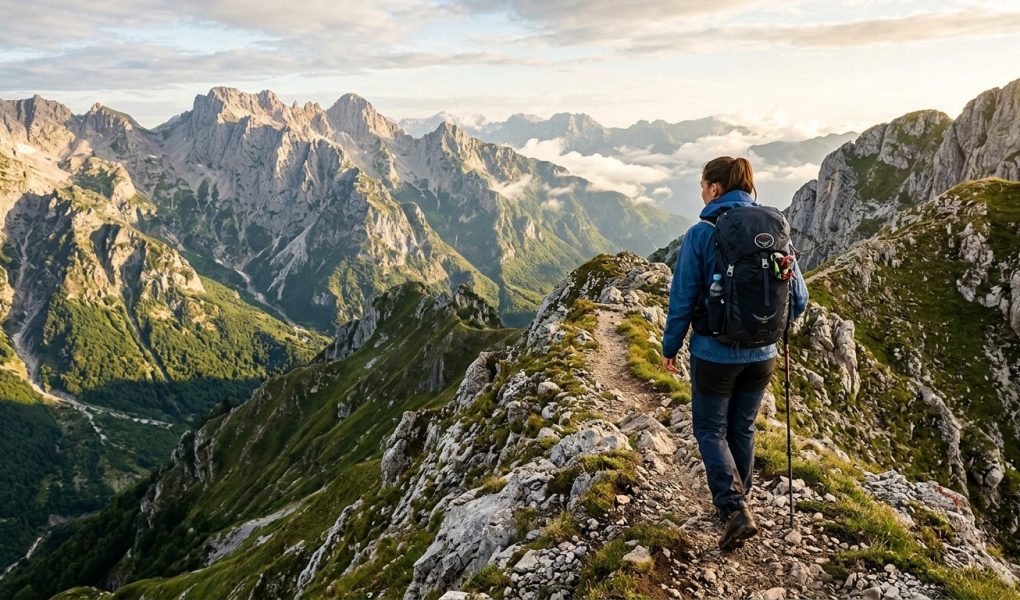
The hike from Valbona to Theth is the region’s signature route. It traces old shepherds’ paths over the Valbona Pass, drops steeply into the Theth valley on the far side, and delivers you into what feels like a completely separate world. The two valleys are only about 18 kilometres apart. The trail between them takes most people seven to nine hours.
The ascent to the pass is long and steady. The path is well-worn by now, though it would not have been ten years ago. You move through beech forest for the first few kilometres. The canopy thins as you climb. The rocks get bigger. By the time you reach the pass itself, you are at roughly 1,800 metres, with long views back down into Valbona and across to the grey ridgelines of the Kosovo border.
The descent into Theth is harder on the knees than the ascent is on the lungs. The path drops sharply through loose scree and then through deep forest. The valley below appears in pieces: a church tower, a guesthouse roof, smoke rising from a chimney. And then you are in Theth, and someone is offering you a coffee before you have even taken off your pack.
“People come here now, yes. But they come for a few weeks in summer. In October, November, it is just us and the mountains again. Like always.”
A guesthouse host in Theth, late September
Family Guesthouses as the Real Infrastructure
The word “guesthouse” conjures something more formal than what you actually encounter in Valbona and Theth. These are homes. Extended family homes, often, where a couple of rooms have been set aside for walkers. You sleep in a bedroom that looks much like any bedroom. Breakfast is at a shared table. Dinner is whatever was growing in the garden or raised on the property.
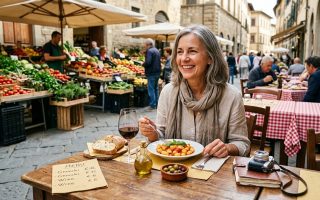
The meals alone justify the trip. Fresh cheese, lamb, cornbread, raki poured without being asked for. The hosts often sit with you and eat, and the conversation, even across a language gap, tends to be worthwhile. They want to know where you came from and why you chose to come here. Sometimes they seem genuinely puzzled by the second question, in a way that is not unfriendly, just honest.
These guesthouses represent the primary economic engine for both valleys. Tourism here is not an add-on. It has, in the space of about fifteen years, become the foundation. That creates a kind of investment in the experience that you do not always find in more developed destinations. The host family’s livelihood and the quality of your stay are more directly connected than almost anywhere else you are likely to travel.
Getting to Valbona
The journey to Valbona is part of the trip. It is not a shortcut kind of logistics situation. Here is the sequence most independent travelers follow:
- Fly into Tirana (TIA) and get to the city centre by bus or taxi from the airport. Budget accommodation is available near Skanderbeg Square.
- Take an early morning bus or furgon north to Shkoder. The journey takes about two hours. Shared minibuses (furgons) depart from the area near the main market and are cheaper than private taxis.
- From Shkoder, catch transport to Koman. This takes roughly two hours on a winding road east. Timing matters here: the ferry departs Koman in the morning, usually around 9am.
- Board the Koman to Fierza ferry. This is the famous lake crossing, two hours through narrow canyon walls over the Koman reservoir. It is genuinely extraordinary and worth getting a seat outside for.
- At Fierza, find transport to Valbona. Waiting furgons or pre-arranged guesthouse pickups cover the final 45 minutes on an unpaved mountain road.
The whole journey from Shkoder to Valbona takes the better part of a day. Every hour of it earns you something. That inconvenience is a large part of why the valley feels the way it does when you arrive.
What to Carry and What to Leave Behind
The trail demands respect. You are crossing a genuine mountain pass in a region with limited rescue infrastructure. That said, you do not need to arrive loaded down with gear for every conceivable scenario. These are the things that actually matter:
- A rain layer and a light insulating layer, regardless of the forecast. Mountain weather above 1,500 metres can change in under an hour.
- Proper hiking footwear with ankle support. The descent into Theth covers several kilometres of loose stone and uneven ground.
- Cash in Albanian lek. Guesthouses do not take cards. Neither do most of the very few shops along the route.
- At least two litres of water from the start, even though mountain streams exist on the trail.
- A downloaded offline map. Apps like maps.me or OsmAnd have reasonable trail coverage and function without any signal.
- A headlamp, in case slower progress means you are moving toward dusk on the descent.
What you do not need: a full camping kit (guesthouses handle accommodation at both ends), or elaborate water filtration if you are only drinking from fast-moving mountain streams above the tree line. Keep the pack light. Every extra kilogram announces itself on the descent.
What the Accursed Mountains Still Have Time to Be
Albania’s tourism numbers are rising. They were essentially nonexistent twenty years ago, then a small steady stream, and now something with more momentum. Theth in particular gets busy in July and August. By Prokletije standards, “busy” still means nothing close to Chamonix or the Dolomites, but the direction of travel is clear enough.
The guesthouse hosts are aware of it. They talk about it the way people talk about weather. Inevitable, possibly welcome, possibly not. They are glad for the income. Some are building extensions. One host showed me the plans for three new rooms with obvious pride. That is a good thing. It means the local economy is growing on local terms. But it also means that the version of this trip that exists right now has a time limit on it.
The version where you hike for three hours without passing another group. Where the host sits down and talks to you like a guest in their home rather than a customer in their business. Where the valley carries that specific, weighted quality of silence that arrived before anything else on the dock at Valbona. That version is still here, fully intact. Come while it is.