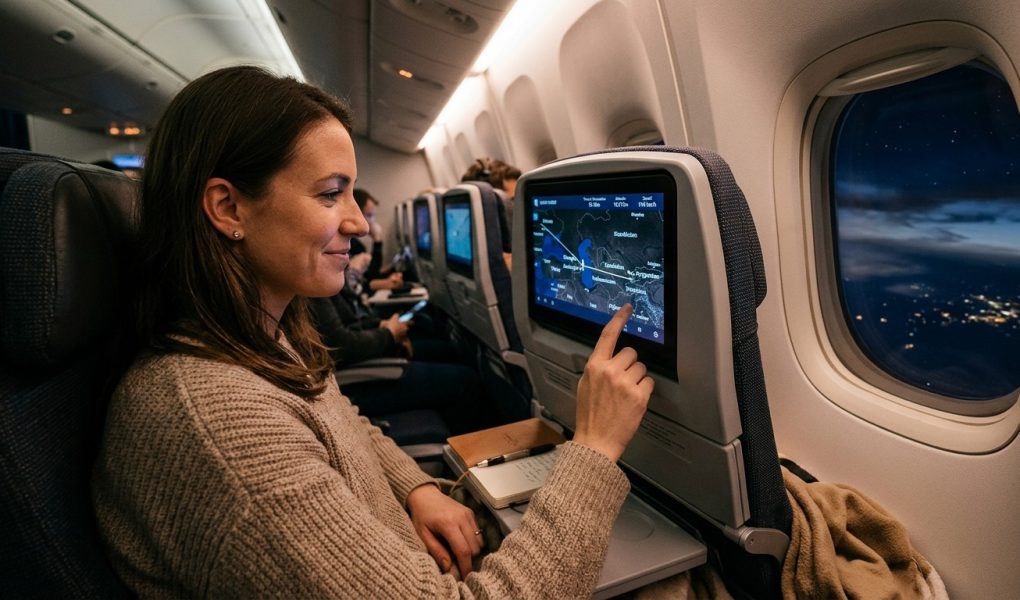
The habit started late on a Tuesday in February. Heating broken, tea cold, no real plans. Travel felt abstract, the kind of thing I talked about more than actually did. But I was not scrolling vacation deals or reading bucket-list blogs. I was sitting in the dark watching planes move across a digital map, each tiny arrow pointing somewhere I had never been.
There is something quietly hypnotic about a live flight map at 11pm. Routes arc across the Atlantic in thin threads. Clusters pulse above Southeast Asia like slow-motion fireworks. A lone dot drifts above the Greenland ice sheet, headed somewhere improbable. You start following one. You wonder where it is going. You wonder, more to the point, what is actually there when it lands.
That wondering has changed every trip I have taken since.
The Slow Signal
Watching planes on a live map is less about logistics and more about rewiring how you think about destinations. Planes fly to places guidebooks ignore. Following unfamiliar routes to airports you have never heard of is a low-cost, high-yield method for finding countries where crowds have not arrived yet, prices are still honest, and the local experience remains intact. This is how quiet corners of the world keep their edges.
Why Guidebooks Keep Sending You to the Same Places
A travel guide, by definition, reflects where other travelers have already been. It is a record of consensus, written months or years before you read it. The places inside those pages are not secrets. They stopped being secrets the moment someone decided to publish them. In the years since, the best cafes from those books have grown queues, the “quiet” neighborhoods have acquired gift kiosks, and the viewpoints have been paved for better parking.
None of this is anyone’s fault. It is simply the way popularity compounds.
The flight map works differently. It shows you where aircraft actually go, not where influencers have been. These are not always, or even often, the same places. Commercial aviation connects a staggering number of destinations. Thousands of airports worldwide receive regular service, according to global civil aviation records, and the vast majority of them never appear in any magazine feature or travel special.
Most travelers funnel through the same thirty or forty gateway cities. The map shows you what lies beyond the funnel.
How an Evening Ritual Became a Travel Strategy
Here is how it usually goes. It is evening. I have a vague sense I want to go somewhere in the next few months, but no clear destination. I resist the obvious choices, partly from stubbornness and partly because the obvious choices feel like a test I have already passed.
I pull up a live flight map and just watch. Within a few minutes I notice routes that do not fit my mental model of the world. A flight from Vienna to Tbilisi. One from Istanbul arcing south toward a city I cannot immediately place. Something departing from Riga toward an airport code I have never seen. I start clicking.
This is not research, exactly. It is closer to eavesdropping on the world’s actual movement rather than its curated, posted version of itself. Planes go where planes go. They do not care about aesthetics or hashtags. They go where people need to travel, where trade happens, where families live across borders. Following those routes is one of the most honest forms of travel research I have found.
I usually end the evening with three or four airport codes I did not know before. Then I start reading.
What These Airports Often Have in Common
The destinations I keep finding this way share certain qualities that I have come to look for:
- Served by regional carriers, not major hubs. This keeps tourist numbers manageable, because connections are inconvenient enough that casual visitors skip them entirely.
- A functioning local economy that does not depend on tourism. This means restaurants, markets, and culture that exist for residents first, not for visitors.
- Absent from most “top ten” lists. If the airport I am looking at already appears in a major travel roundup, I usually keep scrolling.
- Visually distinct surrounding landscape. Mountains, coastlines, deserts, river deltas. The flight map shows geography even before I read a single word about the place.
- Within a few hours of a better-known city. This makes logistics manageable. Fly into somewhere familiar, then travel overland or catch a small regional connection onward.
None of these are rules. They are patterns I have noticed after years of this particular late-night habit.
The Night I Found Osh
Kyrgyzstan was not on my radar at all. I had been vaguely aware it existed, somewhere in Central Asia, somewhere between Kazakhstan and China, somewhere I had never thought seriously about visiting.
Then one evening I was watching a cluster of flights moving above Central Asia, and I noticed a dot landing in a city called Osh. Not Bishkek, the capital, which I had at least heard of. Osh. I had to look it up. I found a city of around 300,000 people, one of the oldest continuously inhabited settlements in Central Asia, sitting at the edge of the Fergana Valley with a bazaar that has operated for centuries. It has a mountain called Sulayman-Too rising directly from the city center, an ancient site of pilgrimage that most visitors to Kyrgyzstan miss entirely because they stay in the north.
I went six months later. The bazaar was everything I hoped for and nothing like anything I had experienced before. The guesthouses were genuinely welcoming and priced for the local market. The hiking above the city was unmarked and unhurried. I did not see a tour group once.
I would not have found Osh in any guidebook I had read to that point. I found it on a map, at midnight, following a plane.
Then the Map Showed Me Kutaisi
Georgia appears more often in conversations about underrated destinations now. But within Georgia, the conversation usually starts and stops at Tbilisi. Maybe Kazbegi for the mountains. Maybe Batumi if someone is feeling adventurous.
Kutaisi is the country’s second-largest city, and it barely registers in most travel writing. I found it the same way I found Osh: watching routes late at night and noticing that a surprisingly high number of budget flights from European cities were landing at an airport I had never considered. I started reading. I found cave monasteries carved into cliffsides. I found a market where vendors sell dried churchkhela and local wine in old lemonade bottles. I found a city that felt genuinely, unhurriedly Georgian in a way that Tbilisi’s tourist center, however charming, no longer quite manages.
The old town is quieter than most European cities I have passed through. The food is extraordinary and almost entirely unknown outside the country. And the people I met there seemed genuinely puzzled, in the best possible way, by the fact that I had come specifically to see their city rather than just passing through on the way somewhere else.
That puzzlement, I have learned, is the clearest sign that you are in the right place.
Where the Planes Go Before Anyone Tells You To Follow Them
The flight map is not a recommendation engine. It does not curate, filter by popularity, or rank destinations by photogenic value. It simply shows you where aircraft go. What you do with that information is the actual work of slow travel: researching, reading, asking questions, and eventually booking something that nobody in your life has strong opinions about.
The habit I am describing is not efficient. It takes time. You follow routes that lead nowhere interesting. You read about airports surrounded by industrial suburbs. You occasionally book a flight based on a late-night hunch that does not entirely pay off.
But the ratio is good. Far better than the ratio of excitement to disappointment I get from following standard travel advice. And the places the map has led me remain genuinely, stubbornly crowd-free in a way that places featured in mainstream travel media rarely stay for long.
The method is simple enough. Open the map. Watch where the planes go. Follow the ones heading toward names you do not recognize. Then start reading. The world is far larger, and far more interesting, than the narrow corridor most travel writing covers. The flight paths know this even when the guides do not.